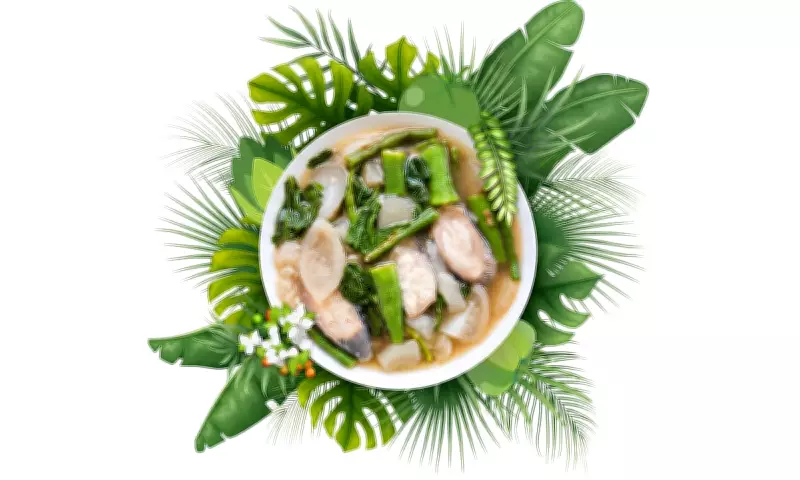
Who knew that the ultimate “clean girl soup” was just the humble “Utan Bisaya” (Visayan vegetable soup) we grew up with? Lately, Western wellness trends have popularized the concept of this kind of soup — an extension of the minimalist, glowing “clean girl” aesthetic. On social media, it refers to light, hydrating and nutrient-dense broths designed to boost the immune system, improve digestion and support radiant skin.
Long before conversations around “clean eating” and nutrient-dense meals became part of modern wellness language, Utan Bisaya was already being prepared in countless Visayan kitchens in its simplest form.
Nutritional Powerhouse
Registered Nutritionist-Dietitian Angela Pauline Sabando of the University of the Philippines Los Baños noted that malunggay, one of Utan Bisaya’s most familiar components, remains one of the most nutritionally significant greens used in Filipino cooking. “Moringa, locally known as malunggay, is rich in calcium, iron, potassium, carotenoids and antioxidants,” she said in a previous interview. She adds that its presence in Filipino households is largely due to its accessibility and practicality in everyday meals. “Some households even have a tree of this vegetable in their backyard (which is more likely in rural areas),” Sabando said.

The Body of Soup
At the base of Utan Bisaya are squash and taro, two ingredients that define the soup’s body and texture. As they simmer, they gradually soften and release natural starches that gently thicken the broth. Squash brings a mild sweetness, while taro adds a deeper, earthy note. Root crops like these play an important role in Filipino dietary patterns, particularly as accessible sources of energy.
Once the base is established, a mix of vegetables follows, often depending on what is available in the household or local market. Okra, string beans, eggplant and luffa (patola) are commonly used. Each ingredient contributes something distinct. Okra slightly thickens the broth, string beans add structure, eggplant absorbs the flavors of the soup and luffa softens into a delicate texture.
In dietary and recipe analysis profiles, a traditional serving of this clear vegetable soup clocks in at a remarkably lean 130 to 160 calories while containing virtually zero fat and zero cholesterol. Science breaks the dish down into a literal fountain of youth: a single bowl delivers over 140 percent of your daily recommended value of Vitamin A, essential for immune function and skin cellular turnover, and nearly 200 percent of Vitamin C, the holy grail antioxidant for collagen production and that coveted glowing skin. It also yields massive percentages of dietary fiber, iron and potassium.
Toward the final stage of cooking, leafy greens such as malunggay and alugbati are added. These wilt quickly in the heat, releasing both color and nutrients into the broth. Sabando highlights malunggay as particularly valuable in addressing common nutritional gaps in Filipino diets.
The Aromatics That Shape the Broth
Before the vegetables come together, the base of the soup is built through aromatics. Ginger, onions, tomatoes and sometimes lemongrass are gently simmered in water, forming a light, fragrant broth. Ginger adds warmth, onions provide depth, tomatoes introduce mild acidity, and lemongrass adds a clean herbal note. Sabando adds that gentle cooking methods also help preserve nutrients in vegetables. “The fiber in moringa is also heat-stable. Moist cooking methods (which involve the use of water, steam, or other liquids), such as brewing, can preserve more of these heat-sensitive vitamins. Water-soluble vitamins, such as Vitamin C and B present in moringa, will infuse into the water used during the cooking process.”
A Final Layer
Seasoning remains minimal — usually salt or fish sauce — just enough to bring all the components together without masking their natural flavors. In some households, Utan Bisaya is served with grilled or fried fish, adding contrast to the lightness of the broth.

Across the Philippines, it is known by different names and slight variations depending on region and available ingredients. In Davao, a similar vegetable soup is called “law-uy,” while in the Ilocos region it is often referred to as “dinengdeng” or “inabraw.” Iloilo has its “laswa” and in Batangas, it is known as “bulanglang.” Though each version varies slightly in composition, they share the same foundation — a medley of fresh, seasonal vegetables simmered into a light, nourishing broth.
As it turns out, our parents were right all along. We didn’t need expensive superfoods, aesthetic jars of imported supplements or Western wellness trends to get that healthy, glowing skin — we just needed to finish our Utan Bisaya.