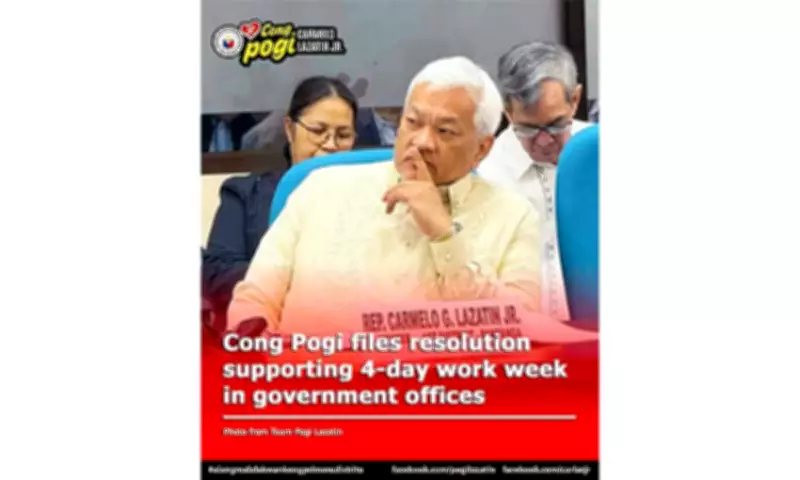
Pampanga First District Representative Carmelo "Pogi" Lazatin, Jr., has formally introduced House Resolution No. 843, which advocates for the adoption of a four-day work week in government offices across the Philippines. This legislative move is strategically designed to conserve energy and mitigate operational expenses, particularly in response to the escalating conflict in the Middle East that threatens global oil prices.
Background and Presidential Support
The resolution follows an announcement by President Ferdinand Marcos Jr., who confirmed that the administration is actively studying proposals to reduce standard working days. Lazatin emphasized the urgency of this measure, stating, "With the escalating conflict in the Middle East, countries are now bracing to cushion the impact of the projected oil price increase in the global economy." This context underscores the need for proactive steps to enhance energy efficiency and financial resilience within government operations.
Proven Success in Angeles City
Drawing from his firsthand experience as Mayor of Angeles City from 2019 to 2025, Lazatin highlighted the tangible benefits of implementing a four-day work week in local government offices. He clarified that essential services, including basic and health services, disaster preparedness and response, and other critical functions, were exempted from this arrangement to ensure uninterrupted public service.

"Our experience in the Angeles City LGU has shown that a four-day work week contributes to savings in operating expenses," Lazatin asserted. He provided specific data to support this claim, noting that electricity consumption decreased from P9,349,450.13 in 2018 to P8,708,225.90 in 2021. This reduction translates to savings of 7%, or P641,224, demonstrating a significant financial impact.
Comparative Analysis and Long-Term Benefits
A detailed comparative analysis of power consumption from 2019 to 2023 in Angeles City revealed that total kilowatts consumed from 2020 to 2023 were consistently lower than the 2018 baseline. This evidence reinforces the effectiveness of the compressed workweek in reducing energy usage over time. Lazatin further explained, "Base sa personal experience natin bilang Mayor, hindi naman napapabayaan ang trabaho sa four-day work week at mas nakakatipid pa ang gobyerno," translating to "Based on our personal experience as Mayor, work is not neglected in a four-day work week, and the government saves more."
Regulatory Framework and Future Implications
The proposal aligns with existing flexible work arrangements authorized by the Civil Service Commission (CSC) through Memorandum Circular No. 06, Series of 2022. This circular permits compressed workweeks, including four-day schemes, in government offices, providing a legal foundation for broader implementation. As the resolution moves forward, it could set a precedent for other sectors to adopt similar energy-saving measures, contributing to national efforts in sustainability and cost reduction amidst global economic uncertainties.