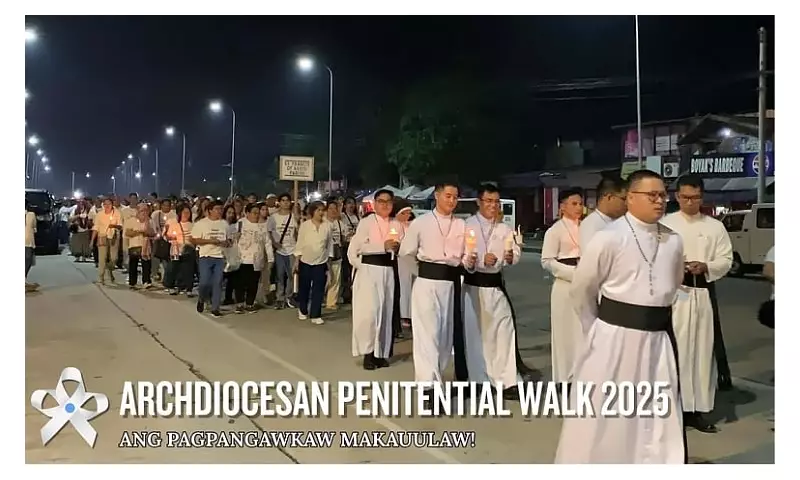
The Archdiocese of Davao led a powerful demonstration of faith and social concern as thousands of Catholics participated in the Archdiocesan Penitential Walk on Saturday, October 25, 2025. The religious procession culminated with the celebration of the Holy Sacrifice of the Mass at St. Peter's Square Agila Stage along San Pedro Street in Davao City.
A Collective Response to National Corruption
This massive religious gathering was organized in direct response to the escalating corruption cases affecting the Philippines. Faithful participants from various vicariates, ACLAIM organizations, and Catholic schools converged from three starting points: Coastal Road Tulip, Magsaysay Park, and Doña Vicenta Park. They walked together in what organizers described as a collective act of humility, repentance, and hope for the nation.
Archbishop Romulo G. Valles personally led the spiritual exercise, urging the faithful to walk humbly with the Lord while praying for forgiveness and renewing their commitment to fundamental values of honesty, integrity, and justice.

National Prayer Campaign for Renewal
The penitential walk forms part of a broader spiritual initiative called the National Cry for Mercy and Renewal. In a circular numbered 45 released on October 4, 2025, Archbishop Valles called upon clergy, religious communities, GKKs (Gagmay'ng Kristohanong Katilingban), families, Catholic schools, and all faithful to participate in this sustained prayer campaign.
The prayer initiative began on October 7, 2025, coinciding with the Feast of Our Lady of the Holy Rosary, and continues on successive Sundays through November 23, the Solemnity of Our Lord Jesus, King of the Universe. The Archbishop specifically instructed that the prayer be incorporated into Masses on the designated dates and encouraged regular recitation in homes, schools, and church organizations.
Addressing the Corruption Crisis
The religious actions respond to a formal call from the Catholic Bishops' Conference of the Philippines (CBCP) for a National Day of Prayer and Public Repentance on October 7. CBCP president Cardinal Pablo Virgilio David cited the country's persistent struggles with both natural calamities and systemic corruption as the motivation for this spiritual intervention.
The prayer itself, titled A National Cry for Mercy and Renewal, contains striking language that directly confronts the nation's moral challenges. It describes the Filipino people as humbled and broken, like a stray sheep that has fallen from the cliff and specifically mentions commonplace corrupt practices that have become normalized in society.
The prayer identifies several concerning behaviors that contribute to the moral decay:
- Bribing fixers and traffic enforcers
- Tolerating lies and falsehood in media
- Accepting donations from plunderers and exploiters
- Covering injustice with silence or convenience
It further highlights how scandalous budget insertions deprive the poor of essential funds for healthcare, education, and welfare, while substandard infrastructure projects and political dynasties perpetuate a cycle of poverty and dependency.
The Reality of Philippine Corruption
The spiritual response comes amid alarming statistics about corruption in the Philippines. According to Transparency International's 2024 Corruption Perceptions Index, the country ranks 114th out of 180 countries with a score of 33 out of 100, indicating high perceived public-sector corruption. This falls significantly below the global average of 43.
Recent developments have brought the corruption issue to the forefront of national consciousness. During his July 28, 2025 State of the Nation Address, President Ferdinand Marcos Jr. ordered a comprehensive audit of flood-control projects, citing potential corruption in hundreds of initiatives.
The subsequent investigation revealed alarming findings:

- The Department of Public Works and Highways audited 9,855 flood-control projects in August 2025
- The Senate discovered numerous projects that were either overpriced or completely non-existent ghost projects
- The House of Representatives launched its own transparent probe into corruption and poor performance in flood control programs
In September 2025, the government formed the Independent Commission for Infrastructure (ICI) to investigate anomalous infrastructure projects, with particular focus on flood control. Testimonies from former engineers revealed that many projects were built with substandard materials in exchange for substantial kickbacks.
The corruption revelations sparked massive nationwide protests known as the Trillion Peso March, with citizens demanding accountability. According to Greenpeace Philippines estimates, approximately ₱1.089 trillion in climate-tagged infrastructure funding may have been lost to corruption since 2023, with a significant portion coming from DPWH flood control projects.
The Archdiocese of Davao's penitential walk and ongoing prayer campaign represent a spiritual counteroffensive to this systemic corruption, combining religious devotion with social consciousness in an effort to heal what many perceive as a nation in moral crisis.