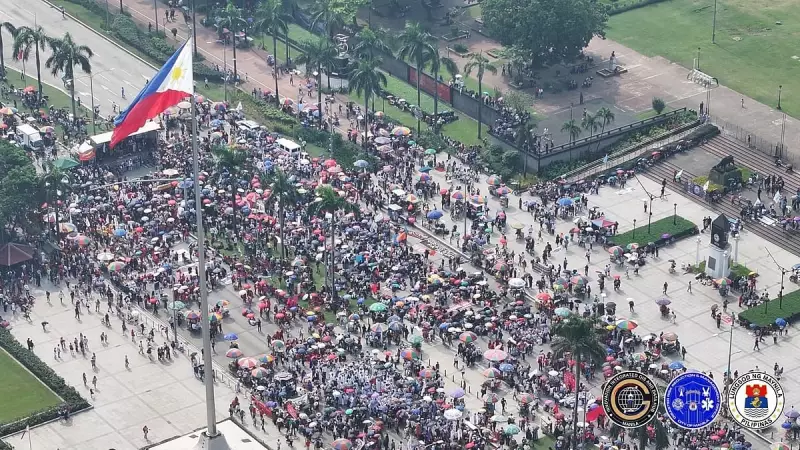
On Sunday, November 30, 2025, a powerful wave of public outrage swept across the Philippines as an estimated 100,000 citizens converged in Manila and other key cities. Their unified demand was clear: immediate accountability for government officials and lawmakers implicated in multi-billion-peso anomalies within flood-control projects.
A Nationwide Call for Accountability
The capital Manila served as the epicenter of the massive protest. At Rizal Park in Luneta, the gathering dubbed "Baha sa Luneta" saw around 3,000 people by 11 a.m., with numbers swelling as the day progressed. The Manila Disaster Risk Reduction and Management Office (MDRRMO) had medical responders on standby for the growing crowd.
Fara Gamalo of Sinirangan Bisayas Kontra Korapsyon voiced the protesters' urgency. "People can no longer wait for all officials to be prosecuted and imprisoned," she stated. Her group advocated for the 'Resign All' call, pushing for a People's Transition Council to oversee the government and enforce a ban on political dynasties during the transition period.

Moral Clarity and the EDSA Spirit
At a parallel rally, the "Trillion Peso March" at the People Power Monument in Quezon City, a significant spiritual tone was set. Cardinal Pablo Virgilio David, President of the Catholic Bishops' Conference of the Philippines (CBCP), officiated a Mass. He had just returned from the Asian Mission Congress in Penang, Malaysia, to join the citizens.
"We returned to EDSA because this place holds the memory of peaceful courage," Cardinal David declared. He urged Filipinos to continue the unfinished work of the 1986 EDSA People Power Revolution, framing the current fight as a call back to truth against greed and impunity. "We gather to protect it—not through force, but through fidelity," he emphasized, acknowledging the nation's fragile yet vital democracy.
Protests Echo from Luzon to Mindanao
The call for justice resonated far beyond Metro Manila, demonstrating a nationwide movement.
- In Cebu City: Archbishop Alberto Uy led a Mass at the Basilica Minore del Sto. Niño, after which thousands dressed in white marched peacefully along Osmeña Boulevard.
- In Tacloban City: Student and youth groups spearheaded actions. Spokesperson Paul Lachica of Bagong Alyansang Makabayan–Sinirangan Bisayas stated that farmers, workers, women, and youth from Samar and Leyte had "flooded" the city to challenge government corruption.
- In Zamboanga City: Clergy and laypeople organized a "Pilgrim Walk for Accountability and Justice." The Formation Center of the Prelature of Isabela de Basilan released a statement calling for accountability, transparency, and truth as the foundation for healing.
The protests are a direct response to corruption charges filed against at least eight lawmakers and several public works officials. They are accused of orchestrating "ghost" and rigged flood-control projects worth billions. These faulty projects have been linked to catastrophic flooding and deaths during storm seasons.
In a related development, on the same day as the marches, one former public works official personally returned 110 million pesos. This sum was part of the 300 million pesos in alleged kickbacks he received from the tainted projects, highlighting the staggering scale of the corruption.