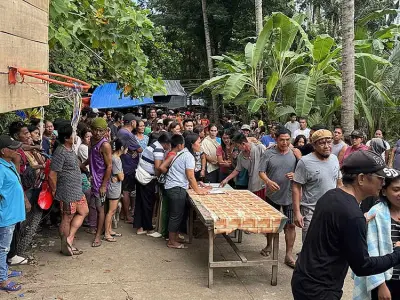
As a young overseas Chinese student who has spent years studying and living in the Philippines, my perspective on China-Philippines relations extends far beyond academic theories. It is shaped by firsthand observations of the deep, tangible connections between the two nations—visible in bustling trade corridors, intertwined livelihoods, vibrant educational exchanges, and grassroots people-to-people interactions. These are not mere abstract figures but living realities that influence daily life and business cooperation in both societies.
The Ambassador's Message on Friendship and Non-Exclusivity
This grounded experience led me to reflect on the repeated public emphasis by Chinese Ambassador to the Philippines Huang Xilian on the concept of "friendship." His assertion that the Philippines can maintain friendly relations with both China and the United States sparked a deeper consideration: Could the Philippines effectively act as a bridge between these two global powers? The country's unique position—bolstered by its historical alliance with the US, extensive economic engagement with China, and its upcoming role as ASEAN chair in 2026—significantly enhances this potential. Ambassador Huang has underscored that "China's friends can also be friends of America and America's friends can likewise be friends of China," challenging the pervasive zero-sum narrative in international relations.
Moving Beyond the "Choosing Sides" Dilemma
Amid intensifying US-China strategic competition, many nations face pressure to align with one camp, but the Philippines confronts a more complex reality. Its national interests are multidimensional, spanning security, economic, and developmental goals. Reducing foreign policy to a binary choice between China and the US oversimplifies these intricacies and risks creating unnecessary tensions. For too long, Philippine foreign policy debates have been framed around a single, divisive question: Should the country side with China or the United States? This presupposes a zero-sum logic where closeness to one power necessitates distance from the other.

However, both theoretical frameworks and the practical experiences of ASEAN members suggest that middle and small states benefit most from strategic autonomy, not alignment within great-power rivalries. The idea that "friendship is not exclusive" directly counters this binary mindset and aligns with ASEAN's realist approach: major-power competition should not dictate the fate of smaller nations. What truly serves the Philippines' fundamental interests is not symbolic loyalty but preserving strategic flexibility, diplomatic maneuverability, and policy independence.
The Philippines' Unique Role as a Bridge
In this context, the Philippines' value as a "bridge" becomes increasingly apparent. Serving as a bridge does not mean erasing differences between China and the US or forcing convergence. Instead, it involves maintaining open channels of communication and cooperative frameworks to prevent competition from escalating into uncontrolled confrontation. The Philippines' uniqueness stems from its multiple identities: as a treaty ally of the United States, it is embedded in a security architecture; as a key economic partner of China, it is integrated into trade and investment networks; and as an ASEAN member, it bears responsibility for regional stability and centrality.
ASEAN Chairmanship and Strategic Implications
Looking ahead, the Philippines' role will gain even greater significance as it assumes the ASEAN chairmanship in 2026, transitioning from a participant to a shaper of the regional agenda. Acting as a bridge is not a passive burden imposed by external pressures but an active demonstration of the country's capacity to manage asymmetrical relationships among major powers. This role carries clear practical implications, particularly during its ASEAN leadership. It does not require the Philippines to mediate the US-China rivalry directly but to prevent Southeast Asia from being trapped in rigid, bloc-based narratives—ensuring ASEAN remains a platform for dialogue rather than a battlefield for competing camps.

Importantly, being a bridge is neither an ambiguous compromise nor an avoidance of choice; it is a sober response to existing power realities. It acknowledges differences without letting them dominate all aspects of relations. For the Philippines, this approach does not weaken sovereignty but represents a more mature exercise of it. At a deeper level, it tests national self-positioning: Can the Philippines articulate a long-term strategy centered on its own interests rather than reacting passively to external pressures? Can it uphold sovereign claims while avoiding the ideological framing of every disagreement?
Personal Reflections and Broader Impacts
As an overseas Chinese student, I care deeply about the trajectory of China-Philippines relations and recognize how vital stable bilateral ties are for ordinary people in both countries. Tensions are not confined to policy documents; they directly affect employment opportunities, educational exchanges, and the future choices of younger generations. Placing bilateral relations on a constant footing of confrontation does not serve the fundamental interests of people on either side.
The Philippines possesses an underutilized advantage in its potential to serve as a bridge. As it prepares for the ASEAN chairmanship, this role endows the country with a unique capacity to incorporate US-China competition into a multilateral framework, buffer bilateral tensions, and help sustain regional stability. Whether this potential translates into a concrete bridging function will directly shape the Philippines' strategic value within the evolving landscape of great-power competition, offering a path toward greater autonomy and influence on the global stage.