House Majority Leader Sandro Marcos Pledges Proper Handling of Impeachment Complaints
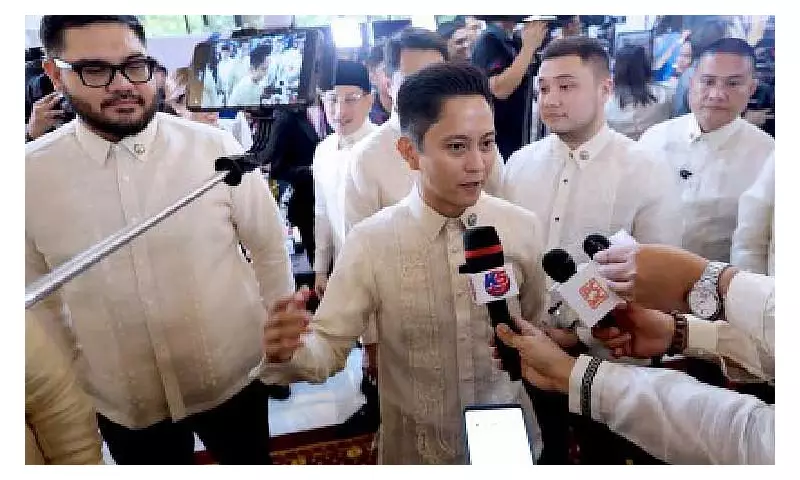
House Majority Leader Ferdinand Alexander "Sandro" Marcos has affirmed that the House of Representatives will not obstruct and will duly process any impeachment complaint filed against President Ferdinand R. Marcos Jr. In a statement released on Friday, Marcos emphasized the constitutional obligation of the House to act on such complaints once formally submitted.
Constitutional Duty and Procedural Steps
Marcos clarified that under the Constitution, the House is required to address any impeachment complaint against impeachable officials. He outlined the procedural pathway: once a complaint is formally filed with the Office of the House Secretary General and transmitted to the Office of the Speaker, it will be referred to the committee on rules for inclusion in the Order of Business and then to the committee on justice.
"Tungkulin ng Kamara, sa ilalim ng Saligang Batas, na aksiyunan ang anumang impeachment complaint na ihahain laban sa sinumang impeachable official (Under the Constitution, it is the duty of the House to act on any impeachment complaint filed against any impeachable official)," Marcos stated.

As Majority Leader, Marcos highlighted his office's responsibility to refer any impeachment complaint to the House Committee on Justice after it is included in the Calendar of Business and read in plenary. He stressed, "Dapat dinggin ng Kamara ang anumang isasampang impeachment complaint, kahit pa ito ay laban sa aking ama (The House must hear and consider any impeachment complaint, even if it is against my father)."
Marcos further emphasized that impeachment is a constitutional process governed by rules and due process, expecting the House to act without prejudice and in accordance with established procedures.
Defense of Formal Filing Requirements
Meanwhile, Lanao del Sur 1st District Representative Zia Alonto Adiong defended the decision of the Office of the Secretary General not to receive an impeachment complaint in the absence of Secretary General Cheloy Velicaria-Garafil. Adiong explained that this action is mandated by House Rules and long-standing parliamentary practice.
"The receipt of an impeachment complaint is not a casual or clerical transaction. It is a formal constitutional act that must strictly comply with House Rules. It cannot be improvised, delegated casually, or reduced to a mere drop-off," Adiong said in a statement.
As chair of the House Committee on Suffrage and Electoral Reforms, Adiong noted that this careful process underscores the importance and gravity of an impeachment complaint. He detailed that under House Rules, impeachment complaints must be formally filed with and received by the Secretary General, who serves as the official custodian of House records and certifications.
"Acceptance of such a complaint is not a merely ministerial act. The Secretary General is required, upon receipt, to determine whether the complaint is complete and whether it complies with constitutional and rules-based requirements on form, including verification, endorsements, and accompanying documents," he elaborated.
Adiong pointed out that in the absence of the Secretary General or a duly authorized acting official, her office cannot validly accept an impeachment complaint. Doing so could raise serious questions about the integrity, completeness, and official acknowledgment of the filing.
"Accepting an impeachment complaint without the Secretary General would expose the House to procedural challenges and claims of irregularity. That would be a far more serious breach of duty," he warned.
He added that the Secretary General's absence is due to a pre-scheduled overseas engagement that is fully documented and publicly known. "There is no refusal to receive any complaint. There is only adherence to the rules that govern how such complaints are properly received," Adiong asserted.
Adiong underscored that rules on filing exist to protect the integrity of the impeachment process, stating, "Impeachment is a constitutional proceeding with grave consequences. It is governed by precision, not convenience. Compliance with the Rules is not obstruction – it is the Constitution at work."