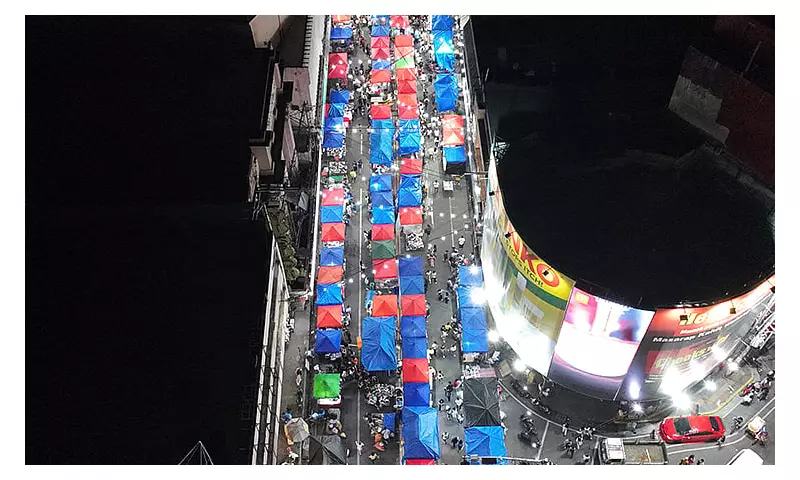
A plan to formally close a section of Colon Street in Cebu City for a night market and bazaar has hit significant regulatory roadblocks. The Cebu City Council has declared that the proposed market cannot legally proceed without securing mandatory approvals from both national and local authorities.
Key Regulatory Hurdles Identified
The council’s committee on laws, ordinances, and styling raised these critical issues in its report on a proposed ordinance authored by Councilor Paul Labra. The proposal sought to authorize the temporary closure of Colon St. from 6:30 p.m. to 2 a.m. for the night market, scheduled to run from October 15 to December 30, 2025.
The committee firmly argued that because Colon St. is officially classified as a national road, its temporary closure requires the official concurrence of the Department of Public Works and Highways (DPWH) before any local ordinance can be legally enacted. The planned full closure would affect traffic flow on Colon St. from Osmeña Blvd. to Pelaez St. and from Junquera St. to Mabini St. An additional closure was proposed for northbound lanes between Pelaez St. and Junquera St.

Required Clearances and Financial Scrutiny
Beyond the DPWH, the committee's report mandated several other clearances. It recommended that the proponent secure favorable recommendations and a detailed traffic plan from the Traffic Management Committee and the Cebu City Transportation Office (CCTO).
Furthermore, the committee, chaired by City Councilor Mikel Rama, emphasized that the Garbo Asenso Sumbanan Alyansa (Gasa) Board must officially approve the night market's conduct. This approval is crucial to ensure that informal vendors comply with established city policies on vending hours, stall locations, and overall operations. The committee also mandated an endorsement from the Cultural and Historical Affairs Commission and a legal opinion from the City Legal Office.
The report acknowledged that a night market was already operating on Colon St., reportedly since September 5. This operation continued after its original permit expired on October 5, prompting Councilor Pastor Alcover Jr. to call for its suspension due to the lack of legislative authorization.
Allegations surfaced that the Participative Association of Sugbo Vendors Inc. (Pasvi), led by Ibrahim “Mark” Dianalan, managed the market under a special permit. Pasvi was reportedly collecting P6,000 per month from over 600 vendors, generating roughly P3.6 million monthly. However, the City Treasurer’s Office had no record of the bulk of these collections, raising serious concerns over unaccounted public funds. Councilor Alcover asserted this arrangement effectively "privatized" a public road for private profit, depriving the city government of lawful income.
Consequences and Next Steps
The committee outlined severe consequences for proceeding without the required approvals. Without DPWH concurrence, the City cannot legally enforce the road closure. Any ongoing market operations could be challenged as unauthorized, potentially exposing organizers and city officials to administrative or legal liabilities. Similarly, the lack of Gasa approval could halt vendor participation and lead to unregulated or unsafe operations.
To move forward, the committee recommended conducting a public hearing on the proposed ordinance. The proponent was also asked to submit key documents from Pasvi, including a Letter of Intent, its latest General Information Sheet, and a board resolution. Residents and stakeholders must be given at least five days’ notice to comment on the planned closures.
The dispute culminated in Councilor Alcover filing graft and administrative complaints before the Office of the Ombudsman-Visayas against Mayor Nestor Archival, City Treasurer Emma Villarete, and City Administrator Albert Tan on October 29. While Mayor Archival defended the night market as beneficial, the City Council insists all procedural and financial irregularities must be resolved before operations can be legally sanctioned.