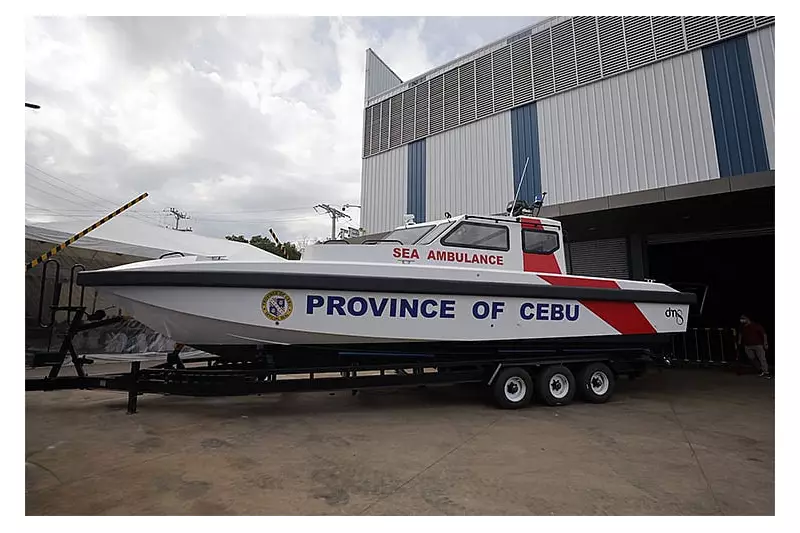
The head of the Cebu People's Action Center (CPAC), Ruben Licera, has publicly defended the Cebu Provincial Government's proposed sea ambulance project against allegations that the vessel is overpriced. Licera stated on Sunday, November 30, 2025, that such claims are based on misinformation and inaccurate comparisons with standard boats.
Addressing Emergency Gaps in Island Communities
In a statement released on his official Facebook page, Licera explained that the sea ambulance was unveiled within the first 100 days of Governor Pamela Baricuatro's administration. The project's primary goal is to address the long-standing emergency transport challenges faced by island and coastal communities across Cebu.
Licera revealed that CPAC receives dozens of requests daily for urgent sea transport. These involve a range of critical cases, including mothers in labor, accident victims, elderly individuals requiring emergency care, and dialysis patients who cannot afford to wait for favorable sea conditions.

He emphasized the human toll behind these emergencies, quoting the governor's promise of "serbisyong paspas, serbisyong makatao" (fast service, humane service). "Behind every emergency message is a Cebuano family praying for help. Behind every delay is a life at risk," Licera said.
Countering the 'Overpriced' Allegations
To counter the criticism, Licera outlined specific technical details that distinguish the sea ambulance from regular pump boats. He stressed that critics are wrongly comparing it to basic gasoline-powered vessels, which are not designed for medical rescue operations.
According to his explanation, the sea ambulance is equipped with commercial-grade diesel outboard engines, similar to those used by military and maritime law enforcement units. The twin-engine package alone costs approximately P9 million, and this does not yet include the expenses for rigging, controls, fuel systems, electronics, and hull integration.
Furthermore, the vessel's hull is constructed with epoxy composite materials commonly used in offshore and rescue operations. Licera described this material as significantly stronger and more impact-resistant than basic fiberglass. These high specifications enable the vessel to operate safely in Sea State 4 conditions, which feature waves as high as 2.5 meters.
"A rescue vessel must go when others cannot," Licera asserted, highlighting the critical need for such a capable craft.
Clarification on Procurement and Status
Licera was quick to clarify a crucial point of confusion: the unit that was launched is a "test vessel" and not a purchased asset. He cited lawyer Harold Sebastian Fleurs, who confirmed that no public funds were used for the vessel since there has been no procurement, bidding, or purchase process.
He explained that government programs can be launched using borrowed or loaned assets, provided the proper documentation is in place. The presence of the provincial seal on the vessel signifies accountability for the program, not ownership of the asset itself.
"As long as Cebu has legal possession, launching is lawful," Licera stated, referencing legal jurisprudence on administrative control.
He also noted that the sea ambulance platform is not a prototype but a proven model already in use by several national agencies. Its capabilities align with the operational requirements of the Provincial Disaster Risk Reduction and Management Office (PDRRMO).
Retired Colonel Dennis Pastor, PDRRMO focal person, emphasized that rescue equipment must be designed for actual danger, not based on a "pwede na" (good enough) mentality. "If your loved one needs rescue, you would want the boat that survives strong waves," Pastor said.
Licera concluded that, as someone who deals directly with sea-based emergencies and witnesses the tragic consequences of delays, he felt compelled to speak out against the spread of misinformation about what he considers a life-saving vessel.