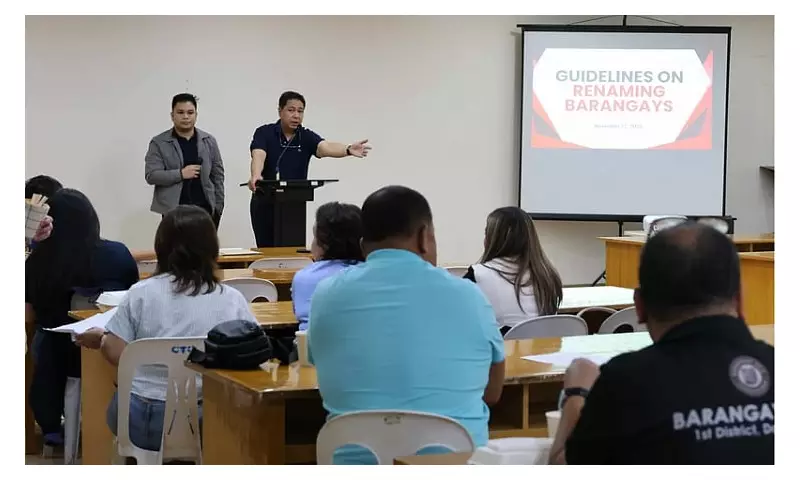
The office of First District Councilor J. Melchor Quitain Jr., in a collaborative effort with the Davao City Culture and Arts Office (DCCAO), has initiated a significant step to reshape local identity. They conducted a specialized seminar for the leaders of 40 barangays located in the Poblacion area. The primary goal of this session was to lay down the guidelines for a proposed ordinance that seeks to replace the numerical designations of barangays within the city's First Congressional District with meaningful names.
Navigating the Challenges of Renaming
Councilor Quitain openly addressed the difficulties inherent in this undertaking. He emphasized that finding suitable names is a complex task, as each proposed name must carry substantial historical and cultural significance. This challenge prompted his office to join forces with the DCCAO, aiming to equip barangay officials with the necessary knowledge and framework for the process. The seminar took place on Wednesday, November 12, 2025, at the Sangguniang Panlungsod.
Oscar Casaysay, the head of DCCAO, led the discussion and provided a deeper perspective. He explained that naming or renaming a barangay goes beyond mere labeling; it is an act of building a community's identity and must adhere to specific legal standards. Casaysay detailed that a barangay's name should be a reflection of its historical or cultural importance. He advised that if an original name is unique, it should be preserved. Furthermore, names must be concise, memorable, and should not be used for natural features like rivers or mountains, which generally retain their existing designations.

Criteria and Community Process for New Names
During the seminar, Casaysay outlined several key factors for barangays to consider when brainstorming new names. These factors include historical landmarks, significant local personalities, indigenous and cultural roots, distinct geographic features, socioeconomic identity, and symbolic or aspirational meanings. He stressed that thorough research is non-negotiable, involving the mapping of notable personalities, landmarks, and pivotal events intrinsically linked to each area.
The push for clearer barangay names was first publicly announced by Councilor Quitain on September 9, 2025. A committee hearing followed on September 15, 2025, where he met with various stakeholders, including the Department of the Interior and Local Government and the Liga ng mga Barangay, to advance the discussion.
The renaming process is recognized as a democratic and challenging endeavor. Each of the 40 barangays will be required to hold a plebiscite where residents will vote on their new name. Barangay captains are tasked with brainstorming potential names with their councils, which must then be submitted to the National Historical Commission for approval. Residents will ultimately choose from three approved options. One potential strategy to streamline the process is to synchronize the plebiscite with the upcoming Barangay and Sangguniang Kabataan Elections, though this would require coordination with the Commission on Elections and a separate, yet-to-be-determined budget.
Emphasizing Cultural and Historical Roots
Earlier, on September 25, 2025, Casaysay had already underscored that this renaming initiative should be integrated into the city's broader cultural mapping project. He insisted that it must not proceed without proper and extensive community consultation. The chosen names, he argued, should serve as tributes to the area's history and culture.
He encouraged barangay leaders to delve into the founding stories of their communities and to identify significant past events. Using the example of Acacia Street, which people still call by its original name long after the trees are gone, Casaysay illustrated how a name powerfully shapes collective memory and identity.
The barangays affected by this proposal are those still identified by number: specifically, Barangays 1-A to 10-A, 11-B to 20-B, 21-C to 30-C, and 31-D to 40-D.