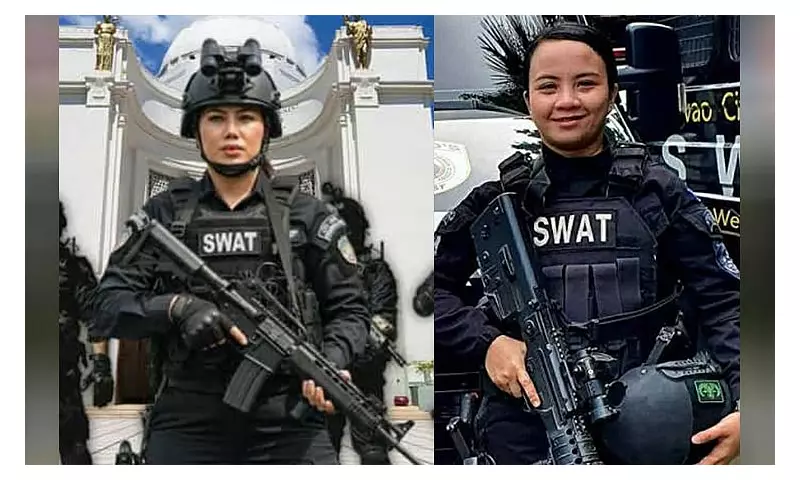
Cebu Governor's AI Defense in SWAT Uniform Controversy
Cebu Governor Pamela Baricuatro has found herself at the center of a legal storm after an image surfaced showing her wearing what appears to be a SWAT uniform. The photograph, which depicts a woman strongly resembling the governor clad in full SWAT attire complete with official patches and insignias while holding a rifle, has sparked a formal complaint. Behind her stand several men dressed in identical combat gear.
Governor Baricuatro's defense is both modern and controversial: Artificial Intelligence created the image. In her public denial, she maintains that she never actually wore the uniform nor posed for such a photograph. The digital creation, she claims, merely resembles her but isn't authentically her.
Legal Expert Questions Whether Digital Use Violates Law
Columnist Junino Padilla, writing in his November 24, 2025 post titled "When Pixels Pretend to be Power," argues that the governor's defense doesn't necessarily absolve her of legal responsibility. He contends that Republic Act #179 of the Revised Penal Code addresses more than just physical fabric—it concerns representation, appearance, and the potential to mislead the public.

"The misuse," Padilla states, "is not harmless. If anything it makes it easier to mislead and more capable of influencing public perception." The legal expert suggests that even though Governor Baricuatro never physically wore the SWAT uniform, her act of posting the AI-generated image satisfies the first element of the crime under Article 179: "the offender publicly and improperly makes use of uniform, insignia or dress."
Padilla presents a compelling legal theory that legislators who passed the Penal Code in 1932 couldn't have anticipated digital creations. The law, though amended multiple times over its 93-year history, now faces interpretation regarding whether digital display constitutes "making use" of a uniform improperly.
Irony in Police-Generated Image
Adding complexity to the situation is the reported origin of the controversial image. Sources indicate the Cebu Provincial Police Office created the AI-generated photograph as a birthday gift for the governor. This creates a significant irony, given that the Philippine National Police has long campaigned against the unlawful use of police uniforms by civilians.
What Governor Baricuatro did do, according to available information, was post the image on her Facebook account, apparently as acknowledgment of the police office's gesture. This act of posting now forms the core of the legal debate: Does the term "make use of" in the law include the publication or posting of a digitally created representation of wearing the uniform?
Intent to Gain and Legal Standards
Complainant Byron Garcia, brother of former governor Gwen Garcia, faces the challenge of proving unlawful intent by Governor Baricuatro. Part of the defense will likely argue that she had no intent of deception or personal gain. As governor of the richest province in the country, what additional opportunities could pretending to be a SWAT member possibly provide?
The case's outcome may hinge on several legal principles favoring the accused. Criminal law requires strict interpretation in favor of the defendant, and the principle of "in dubio pro reo" (in doubt, for the accused) often guides judicial decisions. Additionally, prosecutors are advised to consider not just probable cause but also "reasonable certainty of conviction" when evaluating cases.
Interestingly, Byron Garcia filed what he termed an "administrative complaint" in his initial documentation. However, since his complaint cites the Revised Penal Code provision on unlawful use of uniforms, prosecutors might treat it as a criminal complaint. If they determine it doesn't meet criminal standards, they could dismiss it and direct the complainant to alternative venues like the Ombudsman, the Department of the Interior and Local Government, or the Civil Service Commission.

The case represents a fascinating collision between 93-year-old legislation and modern digital technology, testing whether laws written for physical actions can govern digital representations. As artificial intelligence becomes increasingly sophisticated in generating realistic images, this case could set important precedents for how Philippine law adapts to technological advancements.