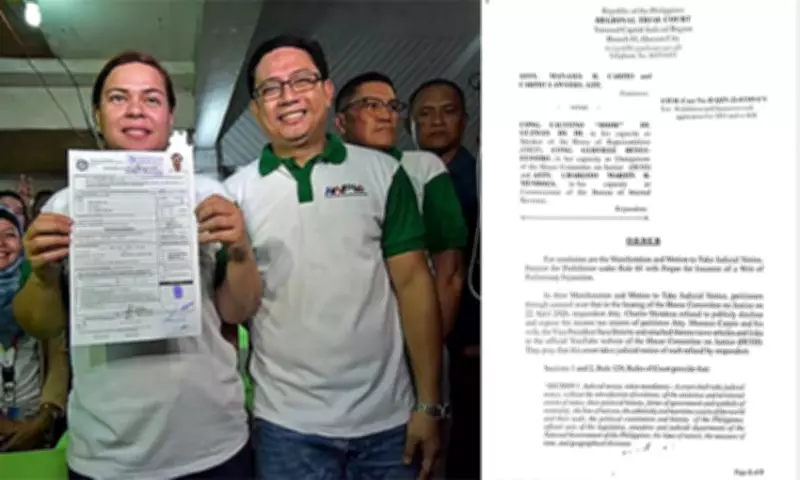
The Quezon City Regional Trial Court (QC-RTC) has dismissed the petition of lawyer Manases Carpio seeking to halt the ongoing impeachment proceedings against his wife, Vice President Sara Duterte. In a five-page order dated May 6, 2026, QC-RTC Branch 81 Presiding Judge Madonna Echiverri ordered the dismissal of the petition for prohibition, citing lack of jurisdiction.
The RTC stressed that prohibition is an extraordinary remedy that applies only against tribunals or officials allegedly acting without or in excess of jurisdiction. The court found that the House Committee on Justice was not usurping authority because the Constitution expressly grants the House the exclusive power to initiate all cases of impeachment.
The court also denied Carpio's request for the issuance of a writ of preliminary injunction, questioning efforts of the House justice committee to obtain and publicly discuss tax-related documents allegedly linked to the couple. Article VIII of the 1987 Constitution provides for the expanded jurisdiction of the Supreme Court on the power of judicial review to determine whether there has been grave abuse of discretion amounting to lack or excess of jurisdiction on the part of any branch or instrumentality of the Government.

In the case at bench, the respondents are acting in the official capacity as part of the House Committee on Justice, a co-equal branch of the government; hence, the case should have been filed with the Supreme Court. Carpio's petition argued that the committee had no jurisdiction over him and over documents attributed to him, including tax returns. However, the court said there was no showing that the House panel acted beyond its legal powers.
The RTC also denied a motion asking the court to take judicial notice of news articles and YouTube links related to the House hearings. The court ruled that such materials cannot be the subject of mandatory or discretionary judicial notice because newspaper reports are considered hearsay unless properly presented for another legal purpose. The order emphasized that injunctions are directed only at party litigants and should not interfere with the functioning of a court, tribunal, or constitutionally created body exercising official duties.
The petition named as respondents House Speaker Faustino Bojie Dy III, House Justice Committee chair Gerville Luistro, and Bureau of Internal Revenue Commissioner Charito Martin Mendoza. During the resumption of the impeachment hearings against Duterte by the House Committee on Justice on April 22, 2026, the Anti-Money Laundering Council (AMLC) submitted its report subpoenaed by the panel on covered and suspicious transactions reported by banks involving the Carpio and Duterte accounts from 2006 to 2025.
In the report, the AMLC said there were 313 covered transactions and 17 suspicious transactions in accounts linked to Duterte during the said period, while 317 and 16, respectively, on accounts linked to Carpio, involving a total of PHP 6,771,227,712.95. Of the over PHP 6.7 billion, the inflows amounted to PHP 4,425,443,794.69, with PHP 1,832,539,360.45 on accounts linked to the Vice President and PHP 2,592,904,434.24 on accounts connected to her husband. The total withdrawals from accounts linked to Duterte totaled PHP 11,211,365,529.75, while PHP 343,315,781.07 on Manases' accounts. The AMLC said there were a total of PHP 791,102,607.44 in undetermined inflow and outflow transactions on accounts linked to the couple.
During the hearing, the AMLC also confirmed 18 similar transactions based on their covered and suspicious transactions report to alleged transfers of money to accounts linked to the Duterte family from alleged drug lord Sammy Uy, as revealed by former senator Antonio Trillanes IV. On April 27, Carpio filed charges before the Quezon City Prosecutor's Office against Bangko Sentral ng Pilipinas Governor Eli Remolona Jr., AMLC Executive Director Ronel Buenaventura, House justice committee chairperson Gerville Luistro, and panel members Percival Cendaña, Chel Diokno, and Leila De Lima over alleged violation of the Bank Secrecy Law, the Anti-Money Laundering Act, and the Data Privacy Act.