Padel vs. Pickleball: A Detailed Comparison of Two Fast-Growing Racket Sports
At first glance, padel and pickleball might appear strikingly similar—both are rapidly expanding racket sports played on smaller courts, often producing thrilling, extended rallies. However, padel is not a British variant of pickleball or any derivative of it. In reality, these two sports possess distinct origins, identities, and developmental trajectories that clearly set them apart. The question on many minds is whether padel can ever match pickleball's soaring popularity. It is still early days, but a thorough understanding of their differences provides a clearer picture of where both sports are headed in the competitive landscape.
What Exactly Is Padel?
According to the International Padel Federation (FIP), padel originated in 1969 in Acapulco, Mexico, when Enrique Corcuera constructed a smaller, enclosed tennis court at his residence. The sport gained momentum in the 1970s, spreading to Spain and Argentina, where it quickly captured public interest. By the 1980s, padel was expanding internationally, aided by formal organizations and innovations such as glass courts. Fundamentally, padel is a racket sport that combines elements of tennis and squash. It is typically played in doubles format on an enclosed court with walls, which not only prolong rallies but also introduce a strategic layer to the game.
Court Design and Accessibility
The court represents the most noticeable distinction between the two sports. A padel court is fully enclosed with glass walls and metal fencing, allowing players to utilize these surfaces during play. Remarkably, players can even step outside the court through designated doors to return challenging shots. The padel court is larger than a pickleball court but smaller than a tennis court, approximately one-third the size of a standard tennis court.

In contrast, pickleball is played on an open court about one-quarter the size of a tennis court. This design allows for easy setup on existing tennis courts with temporary lines, enhancing accessibility in numerous communities. For instance, in Cebu, Talisay City hosts the only padel court in the region, with the first public padel club opening in August 2025 inside the City Hall premises.
Equipment and Gear Variations
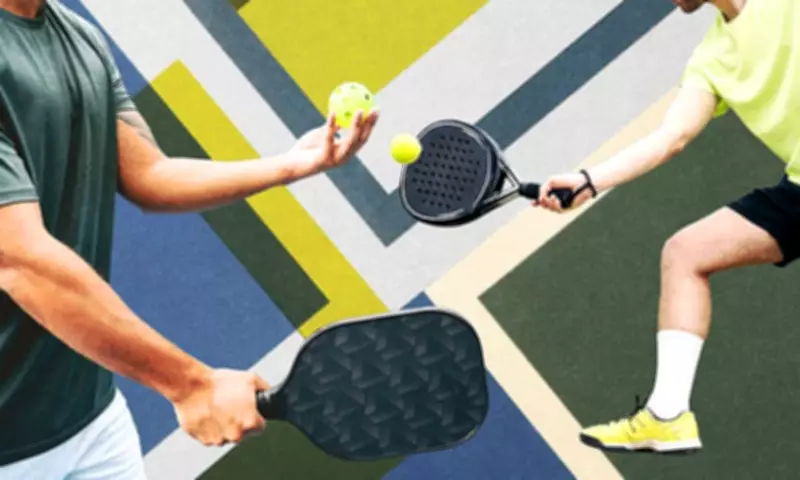
In padel, players employ a solid racket, often referred to as a pala or paddle, which features holes. These rackets are commonly crafted from materials like carbon fiber or fiberglass, weighing between 340 and 390 grams. This weight provides players with enhanced power and control during matches.
Pickleball, on the other hand, utilizes a flat, solid paddle with a rectangular face. These paddles are typically made from graphite or composite materials with a polymer core, weighing around 200 to 240 grams. The lighter weight makes them easier to handle, particularly for beginners entering the sport.
Ball Characteristics and Game Dynamics
Padel uses a ball similar to a tennis ball but with lower pressure, reducing its bounce and making it easier to control within the enclosed court environment. Pickleball employs a lightweight plastic ball with holes, resembling a wiffle ball, which slows down the game and helps maintain controlled rallies.
Scoring Systems and Gameplay Rules
Padel follows a tennis-style scoring system, using points of 15, 30, 40, and game, and is played in sets. Serves must bounce before being returned, and players can strategically use the walls to extend rallies. However, a critical rule stipulates that the ball must first bounce on the opponent's side before contacting any wall; otherwise, it is considered out.
Pickleball uses a simpler scoring system, typically played to 11 points with a win-by-two requirement. Only the serving team can score points. Serves are executed underhand, and the "double bounce rule" applies, meaning the ball must bounce once on each side before volleys are permitted.

Governing Bodies and Global Expansion
Padel is governed globally by the International Padel Federation, which oversees official rules, player rankings, and competitions across more than 100 national federations. Pickleball is led by the International Pickleball Federation, established in 2023, building upon the earlier International Federation of Pickleball. It now includes over 80 member countries and continues to expand its global reach.
During the opening of the Talisay court, Senator Pia Cayetano highlighted the potential for padel to be included in national sporting events such as the Palarong Pambansa. Similarly, ongoing discussions are exploring the inclusion of pickleball in major multi-sport events within the country. Both sports are experiencing steady growth worldwide and are actively advocating for inclusion in the Olympic Games, marking an exciting phase in their respective journeys.