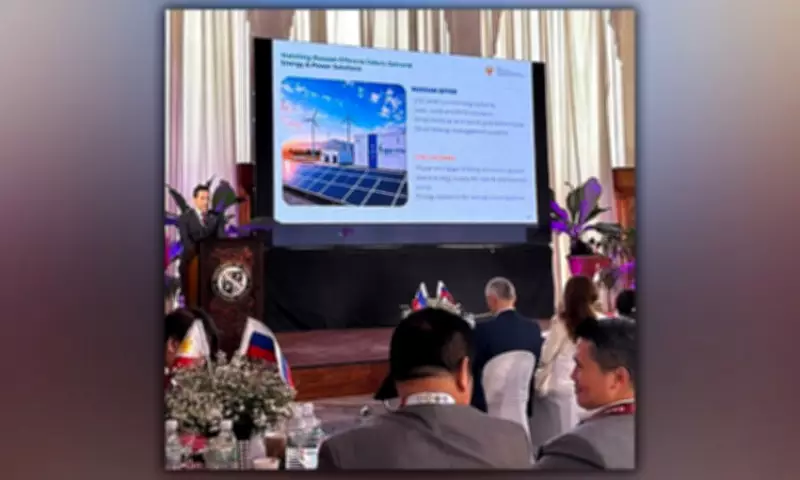
Russia on Friday, May 29, 2026, promoted agricultural, healthcare and renewable energy solutions to Cebu, highlighting new opportunities for trade and investment as both sides seek to deepen economic cooperation.
New Stage of Collaboration
Speaking at the Moscow-Cebu Business Forum, Artyom Tsinamdzgvrishvili, Russia's trade representative in the Philippines, said the two countries are entering a "new stage of collaboration" as they mark 50 years of diplomatic relations. "We have potential for business partnerships across many sectors," he said, citing agriculture, food security, healthcare, digital technologies, infrastructure and energy.
Armi Garcia, honorary consul of Russia in Cebu, said the forum comes at a crucial time as the Philippines and Russia look to expand cooperation in trade, investment, technology, tourism, agriculture, education, infrastructure and the digital economy. Garcia said the event forms part of activities marking the 50th anniversary of diplomatic relations between the two countries and reflects efforts to strengthen economic and people-to-people ties. "Strong partnerships are built not only through government-to-government engagement but, more importantly, through people-to-people and business-to-business collaboration," Garcia said.

She noted that Russia and the Philippines have complementary strengths that could support deeper economic engagement, citing Russia's expertise in science, engineering, energy, information technology, aerospace and advanced industries, and the Philippines' young workforce, growing economy and strategic access to Southeast Asian markets. Garcia added that Cebu's role as a business and logistics hub makes it a strategic location for expanding Philippine-Russian economic relations and attracting future investments.
Proposals for Cebu
Tsinamdzgvrishvili said Russia is positioning itself as a supplier of fertilizers, agricultural machinery and technical support to help boost Cebu's production of rice, coconuts and vegetables. It is also offering poultry, beef, pork, grain, flour, dairy products and vegetable oils to help strengthen food security in the Philippines. The proposals come as the Philippines seeks to improve agricultural productivity and curb food inflation, while diversifying sources of imported food and farm inputs.
Tsinamdzgvrishvili said Russia could also provide diagnostic and imaging equipment, pharmaceuticals, vaccines, telemedicine technologies and specialized medical vehicles to support Cebu's healthcare sector. In energy, he said Russian companies can supply solar and renewable energy equipment, battery storage systems and small-scale power technologies suitable for island provinces. The trade official also promoted Russian digital solutions, including e-government platforms, artificial intelligence systems, cybersecurity tools and smart-city technologies.
Russia-PH Trade
Trade between Russia and the Philippines currently consists largely of Russian exports of meat products, metals, wood and paper products, as well as pharmaceuticals, including oncology and immunology medicines. Russia imports microelectronics and agriculture-derived products from the Philippines, he said. Russian Ambassador to the Philippines Marat Pavlov said business cooperation would be the cornerstone of stronger ties between Moscow and Cebu, alongside cultural and tourism exchanges. He also reiterated Russia's long-standing push for direct flights between the two countries, saying improved air connectivity could boost tourism and business activity.
Cebu's Interest
Cebu Vice Gov. Glenn Soco said the province sees strong potential for cooperation with Russia in healthcare, transportation, infrastructure, information technology and digital innovation. Speaking at the forum, Soco said Russia's advances in medical science and technology could support knowledge-sharing initiatives, healthcare partnerships and medical tourism opportunities. "We recognize the Russian Federation's strengths in several industries that align with Cebu's growth priorities," Soco said.

He expressed interest in improving connectivity between the two regions, including the possibility of direct flights linking Cebu and Russian cities, which he said could help boost tourism and trade. Soco said Cebu is well-positioned to serve as a gateway for Russian businesses seeking opportunities in the Philippines, citing the province's international airport and seaport, growing economy and skilled workforce. "Cebu stands ready to be your partner in the Philippines," Soco said.
Soco said cooperation should move beyond ceremonial agreements and focus on projects that generate tangible benefits for both sides. "Foreign relations today must go beyond ceremonial diplomacy. They must create tangible benefits for our people," Soco said. Soco said healthcare and information technology appear to offer the most immediate opportunities for cooperation, while infrastructure, transport and renewable energy projects could provide longer-term prospects. "We're looking at healthcare because Russia is very advanced, especially in cancer treatment," Soco said during an open forum. He added that Cebu is also interested in information technology and renewable energy partnerships.
Business leaders welcomed the Russian proposals, particularly in tourism, healthcare, transportation and infrastructure. Barbara "Bambi" Gothong, president of the Mandaue Chamber of Commerce and Industry, said Cebu's position as a logistics hub and tourism destination makes it well placed to attract Russian investments.