Businesses that play copyrighted music in their establishments are urged to secure the appropriate public performance license, ensuring compliance with intellectual property laws and supporting creators whose works enhance customer experience and drive sales, according to the Filipino Society of Composers, Authors and Publishers Inc. (Filscap).
Legal Requirement for Public Music Use
Atty. Mark Thursday Alciso, legal counsel of Filscap, emphasized that playing copyrighted music in public—including in restaurants, hotels, retail stores, malls, bars, gyms, and other commercial establishments—requires authorization from copyright owners under the Intellectual Property Code. Instead of negotiating individually with composers and publishers, businesses can obtain a blanket license from Filscap, the only government-accredited collective management organization in the Philippines authorized to license public performance of copyrighted music.
“Businesses can legally play more than 40 million local and international songs through a single license,” Alciso said. Filscap represents about 1,900 Filipino music creators and has reciprocal agreements with around 50 foreign copyright societies.

Benefits of Collective Licensing
Alciso explained that the collective licensing system benefits both copyright owners and businesses. “It is practically impossible for music users to identify, locate and negotiate separately with every composer and publisher whose songs they want to play,” he said. Similarly, it would be difficult for songwriters to monitor every establishment using their music. Under the blanket licensing system, businesses may publicly play any song in Filscap’s repertoire throughout the license period without seeking separate permission for each copyrighted work.
License Fees Based on Business Type
Licensing fees are based on internationally accepted standards, considering factors such as floor area, seating capacity, and business type. For example, a retail store in Cebu with a selling area of 51 to 100 square meters pays an annual license fee of P5,370, equivalent to about P15 per day. A restaurant of similar size pays P10,634 annually for recorded music, or roughly P29 per day. Members of partner business organizations may qualify for discounted rates.
Alciso noted that many business owners initially assume licensing costs are expensive, but change their perspective after seeing the actual rates and the value music brings. “Music helps attract customers, influences purchasing behavior and enhances the customer experience,” he said. “Given that value, the cost of a license should not be an issue.”
Impact of Music on Business Growth
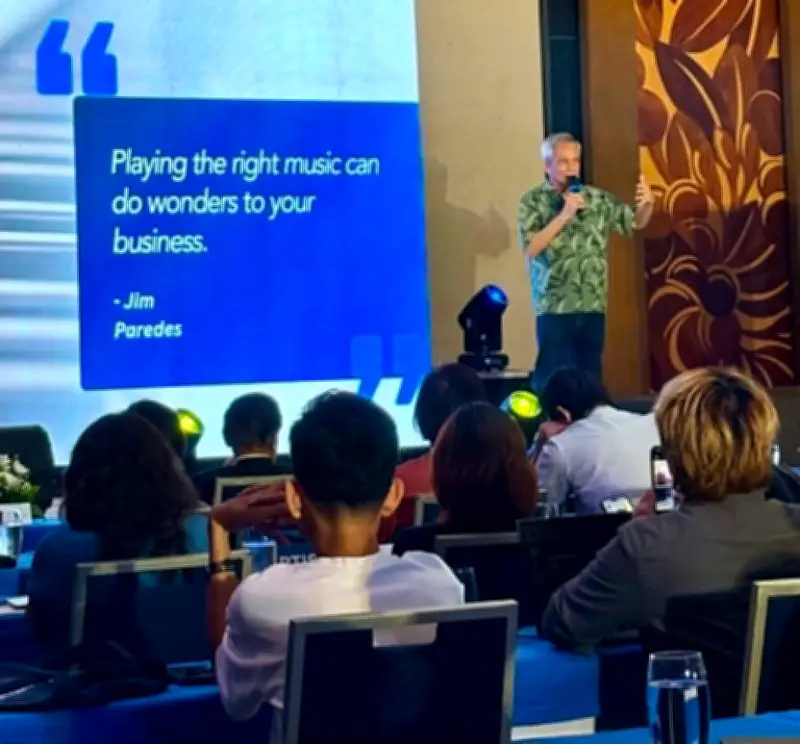
Industry players highlighted music as a vital business tool. Singer-songwriter and Filscap trustee Jim Paredes said music creates emotional connections that influence how customers perceive a business. “Music is more than entertainment,” Paredes said during a Filscap forum in Cebu. “Playing the right music can strengthen brands, influence consumer behavior and help businesses grow.”
Carlo Rivera, assistant director of marketing and communications at Bai Hotel, described music as an “invisible amenity” that shapes guest experiences, encourages longer stays, and increases spending. Rivera said guests today pay for experiences rather than simply products or accommodations, making music an important part of a company’s branding strategy. Hotels carefully curate playlists for different spaces to create the desired atmosphere and strengthen customer loyalty. “Music shapes brand identity, creates ambiance, enhances customer satisfaction and strengthens emotional connections,” Rivera added.