Davao Region's Poorest Households Experience Negative Inflation in 2025 Amid Food Price Declines
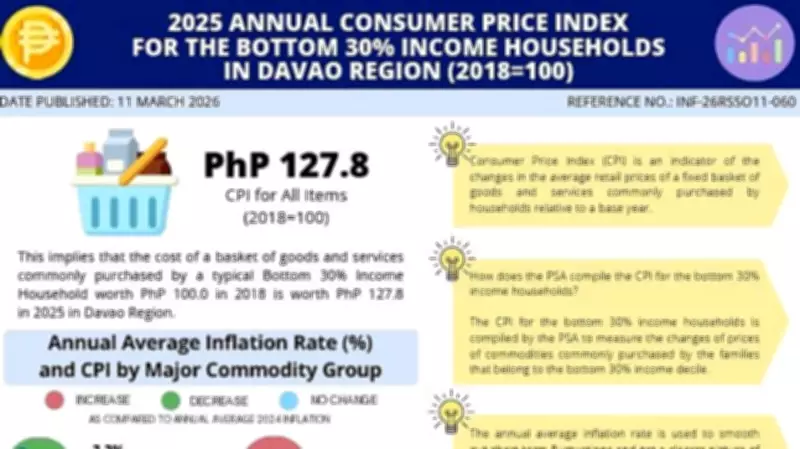
In a significant economic shift, inflation for the poorest households in the Davao Region dropped below zero in 2025, primarily due to a sharp decline in food prices, as reported by the Philippine Statistics Authority (PSA) Davao Region. The annual report, released on March 18, 2026, reveals that the average inflation rate for the bottom 30 percent income households fell to -1.1 percent in 2025, a stark reversal from the 4.3 percent recorded in 2024. This downturn signals easing price pressures for low-income families, particularly in essential goods, although some sectors continued to post increases, highlighting a mixed economic landscape.
Food Prices Lead the Overall Slowdown
Food and non-alcoholic beverages, which carry the heaviest weight in household spending, were the primary drivers of the overall inflation slowdown. Inflation for this category dropped dramatically to -3.3 percent in 2025 from 7.2 percent in 2024. Specifically, food inflation alone fell even further, from 7.4 percent in 2024 to -3.8 percent in 2025, as staple items posted steep declines. Cereals and cereal products led the drop, plunging to -13.2 percent from 13.8 percent a year earlier. Rice prices, a key driver of household expenses, contracted significantly, helping ease the financial burden on low-income consumers. Other food groups, such as fish, fruits, and vegetables, also posted slower increases, reinforcing the broader easing in food costs across the region.
Mixed Price Movements Across Sectors
Despite the overall decline in inflation, several commodity groups recorded faster price increases in 2025, indicating uneven economic pressures. Health-related expenses rose to 4.5 percent, while information and communication climbed to 2.3 percent. Personal care and miscellaneous goods also edged higher, reflecting ongoing cost challenges in these areas. Meanwhile, transport costs slipped to -0.7 percent, and housing-related expenses remained nearly flat at -0.1 percent, suggesting relative stability in utility costs. Prices for restaurants and accommodation services slowed but still grew at 4.6 percent, reflecting sustained demand in the services sector, which continues to influence household budgets.

Provincial Trends Vary Across the Region
Inflation trends varied significantly across provinces and Davao City, underscoring regional disparities. Davao City posted a 1.0 percent inflation rate, the highest in the region, followed by Davao del Sur at 0.3 percent. In contrast, other provinces recorded deflation, with Davao Occidental at -3.7 percent, the lowest in the region. This data highlights uneven price dynamics, with urban centers showing modest increases while several provinces experienced declining prices, pointing to localized economic factors at play.
National Context and Broader Implications
At the national level, inflation for the bottom 30 percent income households also slowed sharply to 0.3 percent in 2025, down from 4.2 percent in 2024. Among regions, the National Capital Region recorded the highest inflation at 2.4 percent, while Soccsksargen posted the lowest at -1.3 percent. The decline in inflation suggests improved purchasing power for low-income families in the Davao Region, particularly as food prices eased after sharp increases in previous years. However, the PSA Davao noted that inflation reflects the rate of price change, not absolute price levels. Even with slower or negative inflation, some goods may still cost more than in earlier years. For many households, the relief from cheaper staples may help offset rising costs in health, personal care, and other essential services—offering a mixed but generally improving economic outlook for the region's most vulnerable consumers.