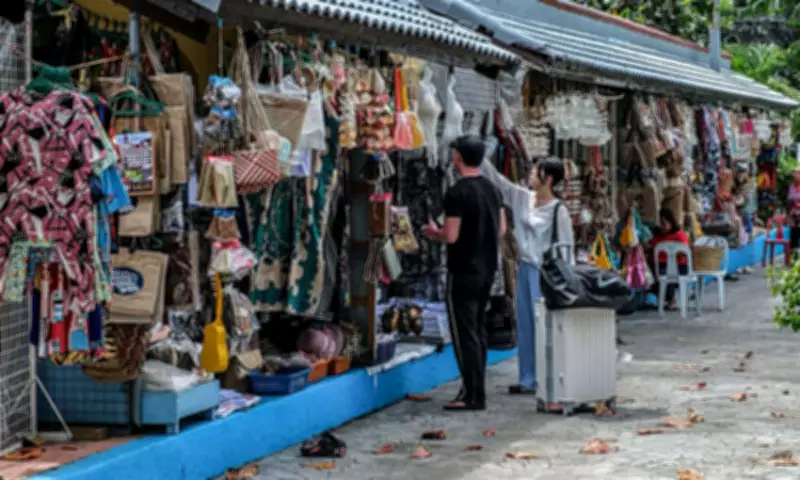
Foreign tourists visiting the Liberty Shrine in Barangay Mactan, Lapu-Lapu City, have been purchasing souvenir items made from seashells and memorabilia, but the once-thriving seashell souvenir business at this historic site has significantly declined. This downturn is attributed to shifts in tourism patterns and the lingering effects of the Covid-19 pandemic.
Vendors Grapple with Reduced Earnings
Melecia Moreno, a 75-year-old vendor selling seashell keychains and chandeliers from her small stall within the Liberty Shrine, revealed that on a good day, she now earns only P300 to P400. This amount barely covers daily expenses, a stark contrast to past decades when her income helped fund the college education of her four children.
Moreno noted that even on days when earnings exceed P1,000, it is still far from the P3,000 to P10,000 she made before the pandemic. Sales typically peak on Mondays and remain strong through Fridays and Saturdays, but slow down from Tuesdays to Thursdays.

"We just have to be patient because our sales have slowed down due to lack of customers... We have to budget strictly, otherwise we can't manage," Moreno added.
Daily Struggles for Long-Time Vendors
Another long-time vendor, Leni (not her real name), 61, shared that her daily income fluctuates between P40 and P200. She explained that not all tourists make purchases, making it difficult to afford basic household necessities like rice.
Despite the minimal profits, both vendors continue their trade as it has been their livelihood for nearly five decades.
Association Highlights Broader Challenges
Minerva Romande, the focal person for the Mactan Shrine Souvenir Vendors Association Inc., representing 30 vendors, disclosed in a separate interview that the business began to weaken during the pandemic when the local tourist site was temporarily closed.
Stalls that once earned P13,000 to P20,000 daily, particularly from t-shirt sales, now generate much less income.
"It hasn't returned to what we earned before Covid-19, but it's not zero—it has just declined, yet we can still survive," Romande stated, adding that souvenir stalls remain a familiar sight for tourists.
Tourism Traffic and Recovery Trends
Passenger traffic at Mactan-Cebu International Airport plummeted during the pandemic, dropping from 12.7 million in 2019 to 2.78 million in 2020 and 1.37 million in 2021 due to lockdowns and travel restrictions.
Domestic travelers decreased from 8.37 million to 1.16 million, while international passengers sharply fell from 4.29 million to just 167,571.
Recovery started in 2022, with traffic reaching 5.58 million, and rose to 11.71 million in 2025, driven primarily by domestic travel resurgence.
Additional Factors Affecting Sales
Beyond Covid-19, other factors contributing to the decline include fewer educational tours, fast-paced tourist itineraries, and limited stall access, according to Romande.
On Olango Island, local artisans also felt the impact of Covid-19 and Typhoon Odette, citing high startup costs and doubled material prices. Romande emphasized the ongoing reduction in educational tours, once considered the "bread and butter" for vendors, which previously brought in many daily customers.
Peak and Slow Periods Identified
Peak sales occur from December to January, during special occasions, and when foreign or Korean visitors arrive. Sales are slowest in June and on days without tour groups.
Based on data from the City Tourism Office, the Liberty Shrine recorded a total of 96,209 tourists in 2025. The highest visitor numbers came from school field trips in May (14.4%), the Kadaugan sa Mactan event in April (12.4%), and the Ironman 70.3 event in August (10.7%), while the lowest were in February (5.9%) and June (6%).
Meanwhile, Lapu-Lapu City welcomed 682,108 tourists in 2025, up from 518,612 in 2024, marking a 31.53% growth rate among Filipino and foreign visitors.
Government Efforts to Revive the Industry
Despite these challenges, the City Government is striving to revitalize the shellcraft industry in Lapu-Lapu.
City Tourism Chief Garry Lao mentioned that the renovated Lapu-Lapu Gallery in Barangay Gun-ob, set to reopen in March or April, will showcase local shellcraft and other products like guitars.

He also plans for vendors to demonstrate how to make items such as shell necklaces at the shrine. Vendors are encouraged to participate in major events and tourist circuits to offer a "one-stop-shop" experience at the shrine and hotels.
Vendors Adapt to Changing Demands
Romande noted that vendors are now diversifying their offerings and continuously innovating their products in response to evolving needs.
Moreno currently sells fridge magnets, wallets, polo shirts, dresses, and statues of Datu Lapulapu, while Leni focuses on keychains. Vendors with decades of service stressed that adaptability is crucial, especially amid competition from other stores and destinations.
Among popular items is the "Bubod" bracelet (P100), a personalized accessory favored by Korean tourists and students from English academies. Making one bracelet takes three to six minutes, depending on the number of letters to embroider.
Even with fewer customers and uncertain daily earnings, vendors maintain their integrity by keeping prices fair.