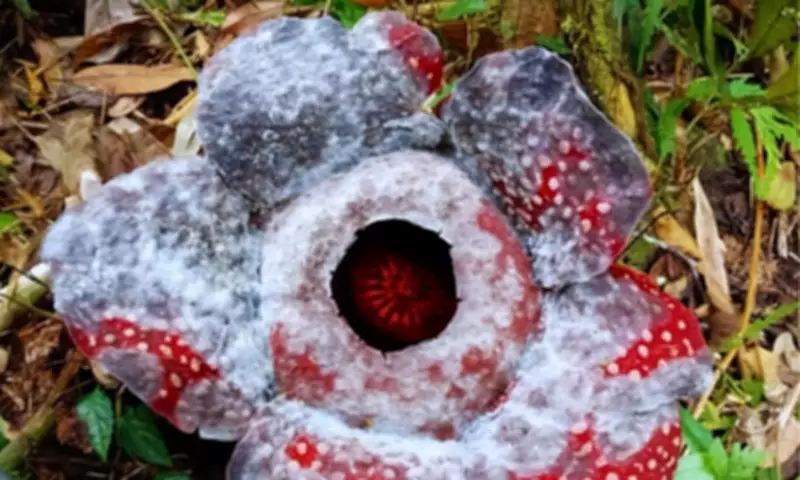
A total of 30 endangered Rafflesia mira plants were recorded within a one-hectare section of high-elevation forest in Tarragona, Davao Oriental, about 1,053 meters above sea level, during a joint assessment by the Lawin Forest and Biodiversity Protection System and the City Environment and Natural Resources Office-Mati City earlier this month, the Department of Environment and Natural Resources in Davao Region (DENR-Davao) reported.
What makes the find particularly significant is not just the number, but the diversity of growth stages observed, evidence of an actively regenerating population.
Ten were fully developed flowers in the anthesis or blooming stage, 13 were developing buds representing the pre-anthesis stage, and seven were senescent flowers naturally wilting after completing their brief but remarkable display, the agency reported.

Often dubbed the corpse flower for its pungent odor, Rafflesia mira is one of the rarest parasitic flowering plants in the world. Unlike typical plants, it has no leaves, stems, or roots and relies entirely on a host vine (usually from the Tetrastigma genus) to survive. Its life cycle is slow and highly sensitive to environmental disturbances, making every confirmed population crucial to its survival.
The discovery underscores the ecological importance of the forested area in Tarragona. As a specialized species, Rafflesia mira serves as an indicator of ecosystem health. Its presence suggests that the forest still supports intact biological relationships, including host plants, pollinators, and the broader web of life that sustains them. The bloom itself, though short-lived, plays a role in attracting carrion flies that aid in pollination, contributing to the continuity of the species.
Its presence in a relatively high density suggests that the site may hold significant ecological and conservation value, likewise provides an important baseline for continued study, monitoring, and the strengthening of protection efforts, the agency said.
The species is classified as endangered under the updated list of threatened Philippine plants issued by the Department of Environment and Natural Resources (DENR). Its protection is reinforced by Republic Act No. 9147, which prohibits the collection, hunting, or destruction of wildlife species and their habitats without proper authorization. Additional safeguards are provided under Republic Act No. 7586 and its expanded version, which promote the conservation of critical habitats and biodiversity-rich areas across the country.
Moreover, conservationists emphasize that preserving Rafflesia mira also means protecting entire ecosystems. High-elevation forests like those in Davao Oriental play a vital role in water regulation, carbon storage, and climate resilience, benefits that extend far beyond the plant itself.
The agency also noted that the surveyed site represents only a portion of the rugged terrain, raising the possibility that more Rafflesia individuals remain hidden deeper within the forest. The concentration of the species, they said, calls for sustained protection and monitoring, not only to safeguard the existing population but also to better understand its distribution and ecological requirements.