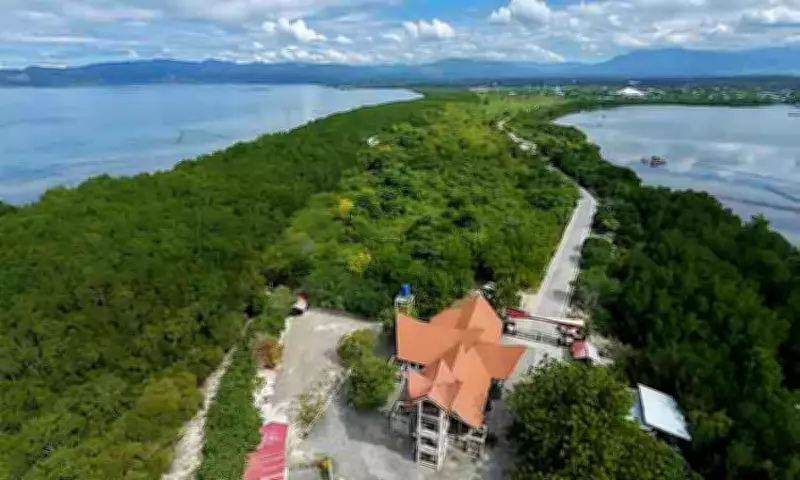
In Guang-Guang Mangrove Park and Nursery, a protected landscape and seascape in Pujada Bay, Mati City, rows of mangrove seedlings line the coast. Yet not all take root: some wither under extreme heat and climate pressures, while others fail to grow despite repeated mass planting efforts.
Covering an estimated 20 hectares in Sitio Guang-Guang, Barangay Dahican, the park serves as a frontline defense against climate change. However, low survival rates raise questions about the effectiveness of current rehabilitation strategies.
Survival Rates and Scientific Gaps
Since 2020, the Mama Earth Foundation has planted five million seedlings in the area, with an estimated survival rate of 70 to 80 percent, according to Amy Ponce, Director of the Regional Integrated Coastal Resource Management Center at Davao Oriental State University (DOrSU). This means 20 to 30 percent do not survive.

Experts emphasize that not all mangroves can grow everywhere. “When you are not in science, the concept of ‘if we plant trees, it’s always good’ is not actually true,” Ponce said. “When you introduce certain species in a certain area, there will be alterations in ecology. You really need to formulate with experts before you do that.”
Mangrove ecosystems depend on precise conditions: soil type, tidal patterns, and wave exposure determine which species thrive. Guang-Guang alone contains multiple ecological zones—from mudflats to sand flats—each suited to different mangrove species.
Costly Mistakes in Mudflats
Improper planting can disrupt entire ecosystems. According to Wetlands International, planting mangroves in mudflats deprives migratory birds of feeding grounds and alters hydrodynamics, leading to erosion elsewhere. Annabel Cabanban, Country Manager of Wetlands International Philippines, stated in October 2025: “When you plant mangroves on non-mangrove areas, the mangroves will either die or destroy the entire ecosystem.”
Large-scale planting efforts often proceed without ecological planning. Ponce noted that during the pandemic, mangroves were planted without proper site matching, resulting in damaged growth and a cycle of replanting.
Success Through Science
When guided by science, restoration shows clear benefits. In properly managed areas, water quality improves and juvenile fish populations increase. Experts stress that successful restoration requires site assessments, species matching, and long-term monitoring—approaches aligned with ecological mangrove restoration.
Extreme Heat and Water Shortages
Extreme heat and limited water supply have further hampered rehabilitation. Jeomar Senagan, head of the Fisheries Division of BFAR-Mati, reported that during the first quarter of 2025, only 10 percent of 5,000 red mangrove seedlings survived. “We have a stock of about 5,000 seedlings here. We keep them watered, but when exposed to direct heat, they die,” he said.
Community and Livelihood Impacts
Mangroves serve as nurseries for fish and crustaceans, supporting coastal livelihoods. Genieve Monares, a fisher from Barangay Dahican, recalled abundant catches when mangroves were healthy. Past activities like illegal cutting and shrimp aquaculture expansion contributed to environmental disturbance.
Illegal logging was once a major issue due to shrimp farm plans. Ponce explained that while shrimp farming continued, it was done without affecting mangroves. “Some areas that were not suitable for shrimp farms were planted with mangroves, properly and with scientific assessments,” she said.
Rising temperatures and environmental pressures underscore mangroves’ critical role as a defense line. However, their effectiveness depends on how restoration is carried out. The assumption of “the more, the merrier” in tree planting may lead to unintended impacts on the ecosystems meant to be protected.