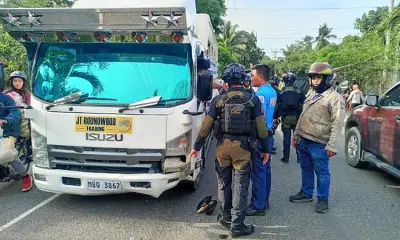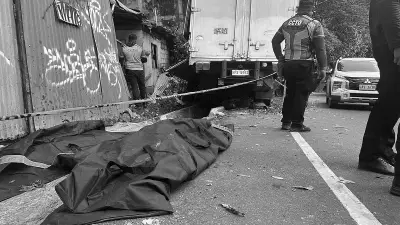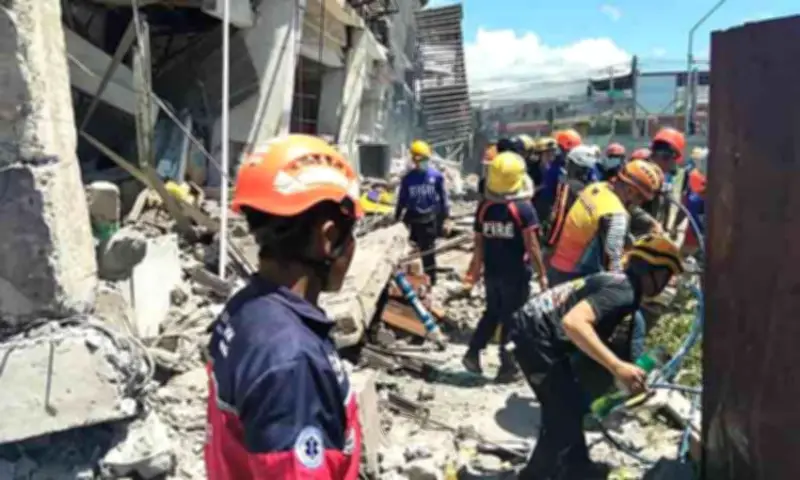
Rescuers are searching through the ruins of a partially collapsed building in General Santos City following a powerful earthquake in the southern Philippines. The magnitude 7.8 earthquake occurred on June 8, 2026, causing significant devastation in the region. As of June 9, 2026, the earthquake has resulted in at least 37 deaths and displaced over 32,000 people.
The death toll in the Davao Region from the magnitude 7.8 earthquake that struck off the coast of Maasim, Sarangani, on June 8, 2026 has risen to 12, while 13 people remain missing and more than 36,000 residents have been affected, according to the latest data from the Regional Disaster Risk Reduction and Management Council-Davao (RDRRMC-Davao) and the Office of Civil Defense-Davao (OCD-Davao).
As of June 10, OCD-Davao recorded 12 fatalities, 41 injured individuals, and 13 persons still unaccounted for as search, rescue, and relief operations continue across the region.

The casualties were reported in several areas, including seven deaths in Jose Abad Santos, Davao Occidental; three in Balut Island; one in Malita; and one in Digos City.
The earthquake, which struck at 7:37 a.m. on June 8 with an epicenter located 32 kilometers west of Maasim, Sarangani and a depth of 33 kilometers, affected 36,056 individuals or 8,694 families across 57 barangays in the region. Authorities said validation of affected populations remains ongoing and figures may still change as additional reports are received from local government units.
Coastal villages still isolated
Two days after the powerful tremor, emergency responders continue to face challenges reaching several remote communities in Davao Occidental. The OCD-Davao on Monday night deployed an aerial assessment and relief mission from Malita to Jose Abad Santos after road access to several barangays was cut off by landslides and damaged infrastructure.
Franz Irag, OCD-Davao chief of operations, said 15 personnel from the Philippine Army, the Provincial Disaster Risk Reduction and Management Office of Davao Occidental, and the Municipal Disaster Risk Reduction and Management Office of Jose Abad Santos were sent to conduct ground assessments and deliver food and water to affected residents.
Despite ongoing efforts, six coastal barangays in Jose Abad Santos have yet to be reached. "Naay six ka barangay sa coastal area sa Jose Abad Santos nga wala pa na-validate ug dili pa maabot," Irag said during a Davao Peace and Security Press Corps. Authorities initially explored sea access to the isolated villages, but the Eastern Mindanao Command and the Philippine Coast Guard advised against the option due to rough sea conditions and existing maritime restrictions.
Search for missing continues
Irag emphasized that authorities remain focused on locating the 13 missing persons and have intensified search and rescue operations. "Dili nato i-presumed dead ang mga nawala — isa na sa atong mga gina-prioritize karon. Gina-mobilize nato ang Philippine Army being the lead of SRR, kay dili pa man nato maingon kung kanus-a naay mamahimong retrieval," he said.
More than 200 responders, including personnel from the Army's 73rd Infantry Battalion, remain deployed in affected areas to support rescue, relief, and assessment operations.
Hundreds of homes destroyed
Initial damage assessments showed extensive destruction to residential properties. RDRRMC-Davao reported that 578 houses were damaged by the earthquake, including 538 that were totally destroyed and 40 that sustained partial damage. Validation of reports continues in coordination with local government units and the Department of Social Welfare and Development (DSWD).
Thousands of residents remain displaced by the disaster. Authorities reported that 1,332 families, equivalent to 4,455 individuals, are currently staying in 10 evacuation centers established across affected areas. Another seven families, or 35 individuals, are temporarily sheltering outside evacuation facilities.

Landslides and Infrastructure Damage
The earthquake triggered at least six landslides across the Davao Region, including slope failures in parts of Sarangani and Davao Occidental. Irag said they are coordinating with the Mines and Geosciences Bureau to monitor areas vulnerable to additional landslides, particularly as localized thunderstorms continue to affect quake-hit communities. "Localized thunderstorms are occurring in some affected areas, which may further saturate the ground and increase the risk of additional landslides," he said.
Damage to public infrastructure has also been reported. Authorities estimated infrastructure losses at around P500,000, affecting at least 92 infrastructure assets. The disaster council reported that 16 roads, three bridges, and seven power facilities were affected by the earthquake. Three national roads remain impassable, while six barangays in Jose Abad Santos continue to experience power outages. Two seaports — Mabila Port and Balangonan Port — also sustained damage, while inspections of other critical facilities remain underway.
Relief Operations Intensify
Government agencies have so far distributed approximately P2.04 million worth of humanitarian assistance to affected communities. Of the total assistance, around P1.48 million came from DSWD-Davao, while OCD-Davao provided roughly P565,000 in relief support.
Irag said relief supplies pre-positioned in Balut Island and nearby communities are already being distributed, while additional aid is being coordinated through national government agencies. "It is part of our response efforts. After the emergency phase, we also expect support for families who lost their livelihoods, businesses, and sources of income. We continue to coordinate with member agencies and the NDRRMC to ensure assistance reaches affected communities efficiently," he said.
Authorities have activated disaster response clusters, placed the Emergency Operations Center under Red Alert status, deployed emergency communication equipment including Starlink units, and continued rapid damage assessments across affected areas.
The earthquake also prompted the suspension of classes in 49 local government units and government work in 12 local government units as officials prioritized safety inspections and emergency response efforts.
Officials said casualty figures, damage reports, and the number of affected residents remain subject to validation as response teams gain access to previously isolated communities.