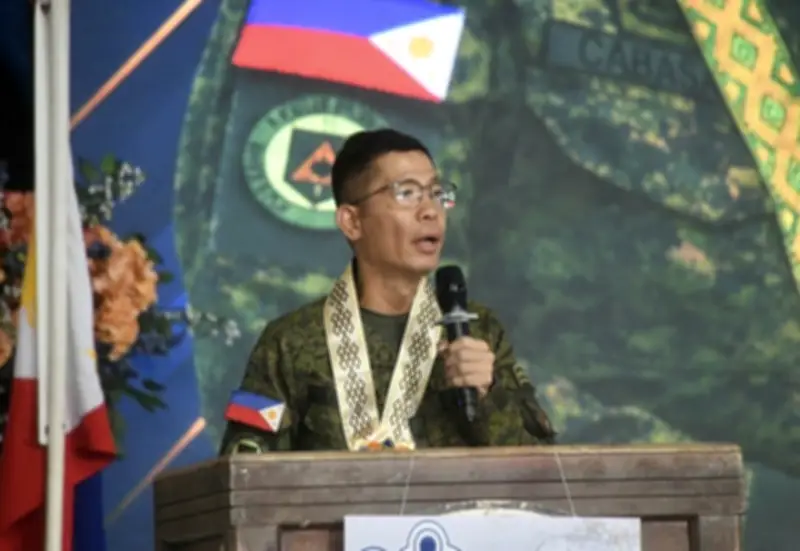
Brigadier General Emmanuel Cabasan, commander of the 1103rd Infantry “Kalis” Brigade, has called on local government units, uniformed services, and communities to strengthen disaster resilience by embracing preparedness as a shared responsibility, citing Sulu's transformation from decades of armed conflict into a model of collaborative disaster resilience-building.
From conflict to resilience
Cabasan, in his message of support during the Regional Kick-Off Program of the National Disaster Resilience Month (NDRM) 2026 on Friday, July 3, at the Municipal Gymnasium in Liloy, Zamboanga del Norte, recounted Sulu's remarkable journey following the end of five decades of armed conflict in 2022. He emphasized that while peace has become the province's new normal, natural hazards continue to threaten vulnerable communities.
Recognizing that the Armed Forces of the Philippines' (AFP) mission extends beyond internal and external security to humanitarian assistance and disaster response, Cabasan initiated a partnership among the AFP, local government units, and the Office of Civil Defense-9 (OCD-9) to strengthen disaster preparedness in Sulu's municipalities. The initiative was inspired by the province's vulnerability to earthquakes, tsunamis, storm surges, and flooding, as well as the need to rebuild institutional capacities after years of conflict that limited opportunities for organized disaster management training.

Partnership yields results
The partnership gained strong support from municipal government leaders and OCD-9. Since the program began in June 2025, seven of the eight Municipal Disaster Risk Reduction and Management Councils within the brigade's area of responsibility have completed Disaster Risk Reduction and Management Orientation and Incident Command System (ICS) trainings. One municipality has already advanced to ICS Level 2, while several others are preparing to undertake higher-level capacity-building activities.
To date, 354 municipal DRRM council members and 310 barangay officials and reservists have completed disaster preparedness training, significantly strengthening local emergency response capabilities. Cabasan highlighted that one of the initiative's major accomplishments has been shaping the mindset of local government agencies, with municipal departments now recognizing disaster risk reduction and management as a shared responsibility rather than solely the concern of the Municipal DRRM Office.
Interoperability and expansion
He also noted the strengthened interoperability among local governments and uniformed services—including the AFP, Philippine National Police (PNP), Bureau of Fire Protection (BFP), and Philippine Coast Guard (PCG)—which train together using common procedures, operational frameworks, and incident management systems. The success of the initiative prompted the 11th Infantry “Alakdan” Division to direct the expansion of the disaster resilience-building program to other municipalities in Sulu beyond the brigade's area of responsibility.
The activity, organized by OCD-9, carried the theme “Naghahanda at Kumikilos Tungo sa Panatag na Bagong Pilipinas.” The event was attended by distinguished guests, including Zamboanga del Norte Governor Darel Dexter Uy, Lawyer Ruel Halanes (OCD-9 regional director), Mayor Roberto Uy Jr. of Liloy, other local chief executives, officials from national, regional and provincial line agencies, representatives from the AFP, PNP, BFP, PCG, disaster risk reduction and management practitioners, and other stakeholders from across Region 9.
Recognition and call to action
The province's growing commitment to disaster preparedness was further recognized when OCD-9 selected Sulu as the ceremonial venue for the Second Quarter National Simultaneous Earthquake Drill. “Our journey in Sulu taught us that resilience is not built after a disaster, it is built long before the disaster comes. The prevailing peace in Sulu gave us the opportunity to prepare. Preparation will enable us to preserve that peace and protect the gains we have worked so hard to achieve,” Cabasan emphasized.

He concluded by encouraging other local government units to draw inspiration from Sulu's experience. “If Sulu, with all its geographic isolation and its decades of conflict, was able to build disaster resilience through partnerships, then every community in Region IX can do the same,” he said. Cabasan also expressed his appreciation to OCD-9 for its unwavering partnership in bringing disaster resilience programs to Sulu and for fostering stronger collaboration among government agencies and local communities.
The Regional Kick-Off Program reaffirmed the commitment of government agencies, local government units, and partner organizations to build safer, more resilient communities through proactive disaster preparedness and collective action in support of a Panatag na Bagong Pilipinas.