Despite reforms that made legal adoption faster and free of charge, illegal adoption arrangements continue to persist through direct placement deals and social media schemes. Concepcion Solera, head of the National Authority for Child Care (NACC) in Central Visayas, said the agency continues to encounter baby-selling and unauthorized adoption activities online and offline.
Why do illegal adoption schemes continue?
Online deals exploit longing
Solera said some people still turn to illegal adoption because they want a child immediately or wrongly believe online transactions are easier than legal adoption. Social media has allowed baby-selling schemes to appear like ordinary online buying and selling, exposing prospective adoptive parents to scammers and children to trafficking risks.
Law has changed
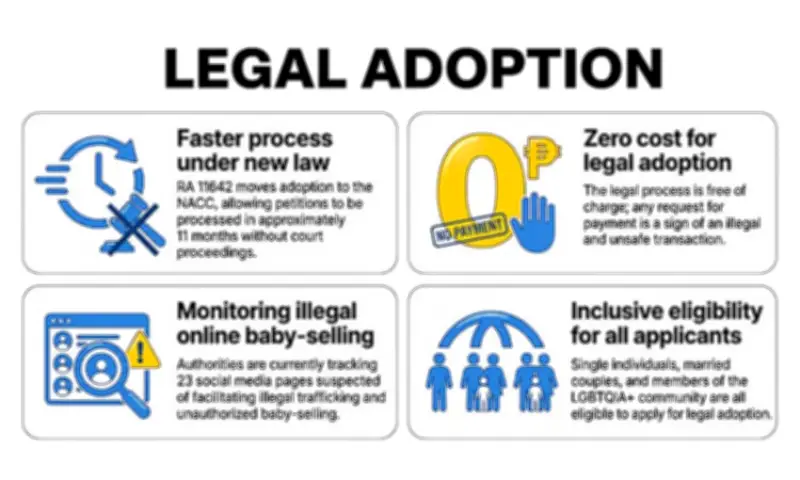
Republic Act (RA) 11642, or the Domestic Administrative Adoption and Alternative Child Care Act, has moved domestic adoption from the courts to the NACC. Adoption no longer requires lawyers or court proceedings. In Central Visayas, Solera said an adoption order may now be issued in around 11 months from the filing of a petition.

Children face danger
Solera said one child in Central Visayas was recently rescued through an operation coordinated by the Inter-Agency Council Against Trafficking after the case was reported through the Cebu City Social Welfare and Development Office in Guadalupe, Cebu City. The biological parents were arrested. The NACC is also monitoring 23 Facebook pages nationwide suspected of facilitating baby-selling and illegal adoption.
Legal adoption protects families
Solera said legal adoption has no cost, and anyone asking for payment is not following the legal process. She said single individuals, married couples and members of the LGBTQIA+ community may apply to adopt, subject to assessment by social workers. Poverty alone, Solera said, should not be treated as a reason to give up a child because adoption remains a last option when family preservation is still possible.