BANKING giant BDO Unibank warned that the prolonged conflict in the Middle East could further weaken the Philippine economy through higher oil prices, faster inflation, rising interest rates, and a weaker peso.
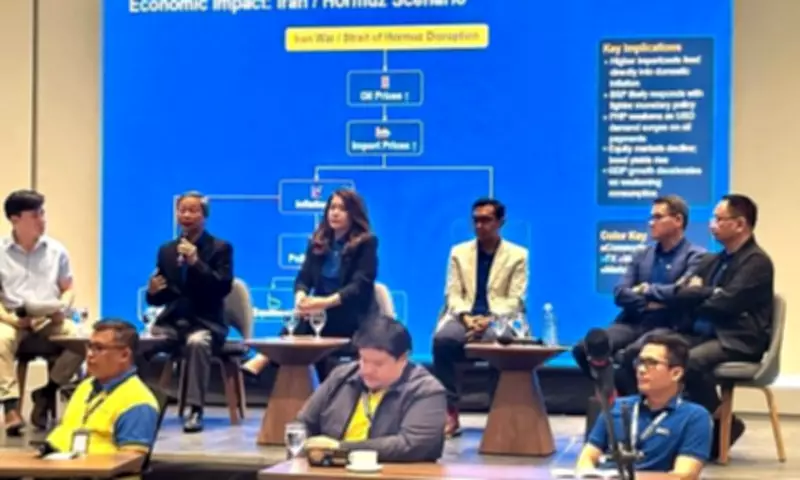
Speaking during BDO’s first-ever economic briefing in Cebu held at the newly opened BDO Corporate Center on Tuesday, May 26, 2026, Federico “Fritz” Ocampo, senior vice president and head of investment management under the bank’s Trust and Investments Group, said the longer the geopolitical tensions persist, the more painful the impact will be for the Philippines.
“The longer the conflict, and we are now on its third month, the more painful for the Philippines,” Ocampo said.

He said the country is expected to face slower economic growth, higher inflation, further monetary tightening, peso depreciation, and a range-bound stock market amid global uncertainty.
Oil prices at the center of risks
Ocampo noted that oil prices remain at the center of the economic risks facing the country, citing the Philippines’ heavy dependence on imported fuel and agricultural inputs such as fertilizers and pesticides.
“It all starts with oil,” he said, explaining that higher crude prices translate into more expensive gasoline and diesel, which then increase transportation and food costs.
He warned that elevated fuel prices could further squeeze household spending power and reduce consumer demand.
“As inflation goes up, consumers can spend less,” he said.
Monetary tightening and peso pressure
Ocampo also said the Bangko Sentral ng Pilipinas (BSP) may continue raising interest rates to contain inflationary pressures, adding that the central bank could bring policy rates from 4.5 percent to as high as 5.25 percent to 5.5 percent.
He added that the peso is expected to remain under pressure as rising import costs increase demand for dollars.
The BDO executive also flagged the impact of higher global commodity prices on food security, noting that the Philippines remains vulnerable because of its reliance on imported agricultural inputs.
He said weaker economic conditions are already being reflected in slower growth figures. Ocampo cited first-quarter gross domestic product growth of 2.8 percent, significantly below the country’s pre-pandemic average of 6.4 percent.
As the country enters the second half of the year, Ocampo said household consumption, investments, and government spending may continue to face headwinds from inflation and geopolitical uncertainty.
Bank sector remains strong
But despite these headwinds, Ocampo said the banking sector remains fundamentally strong.
“BSP Gov. Eli Remolona always reassures the public about stability,” he said, citing the industry’s low non-performing loan (NPL) ratio and ample liquidity.
According to Ocampo, the banking sector’s NPL ratio remains below three percent, indicating that problematic loans account for only a small portion of total industry lending.
“That’s very good,” he said.
NPL is a loan that a borrower is no longer paying on time. In the Philippines, banks usually classify a loan as an NPL when payments are overdue by 90 days or more. A high NPL level means more borrowers are struggling to pay debts. It can signal economic stress for households or businesses. Banks may become more careful in lending money.
Besides manageable NPLs, Ocampo also noted that banks continue to maintain substantial liquidity buffers, with around P1.8 trillion parked in facilities of the BSP, signaling lenders still have enough reserves to support lending activities.
“Although the economy is slowing down, loans are still growing,” Ocampo said, noting that loan growth among major banks remained positive in the first quarter at around nine percent to 13 percent.
He added that banks have remained prudent in extending credit, particularly to the property sector, even during the country’s pre-pandemic economic expansion.
“All of the banks were very careful in extending growth, even to the property sector,” he said.
The economic briefing was organized by BDO to provide stakeholders in Cebu and the Visayas with insights into emerging economic and financial trends affecting consumers, investors, and businesses.