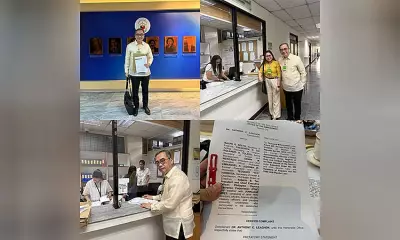
The Cebu City Council has voted to seek a legal opinion from the Department of the Interior and Local Government (DILG) regarding the legality and administrative implications of implementing separate workweek schedules for the city's executive and legislative departments. The move comes amid growing public confusion and concerns over operational efficiency.
Divergent Work Schedules
The issue arose after Mayor Nestor Archival ordered executive offices to return to a regular five-day workweek, ending the compressed four-day schedule previously adopted for energy conservation. However, the legislative department, under Vice Mayor Tomas Osmeña, continues to observe a compressed four-day workweek from Monday to Thursday, with offices operating from 8 a.m. to 6:30 p.m. and remaining closed on Fridays.
During the City Council session on Tuesday, May 26, 2026, Councilor Pastor “Jun” Alcover Jr. delivered a privilege speech questioning the operational impact of the setup. According to Alcover, the arrangement has disrupted coordination between the executive and legislative branches and caused inconvenience to the public transacting with City Hall offices.

“There is now a serious disconnect in government operations,” Alcover said. He pointed out that executive employees can no longer coordinate effectively with legislative offices beyond regular office hours since executive offices already close earlier. Likewise, executive personnel who need signatures, approvals, or documents from legislative offices on Fridays are unable to transact because legislative offices remain closed. “As a result, delays in official transactions, confusion in inter-office coordination and inconvenience to the public have become inevitable,” he said.
Alcover also questioned the consistency of the City Government’s energy conservation policy. He noted that while the legislative department continues to justify the compressed workweek as part of energy-saving efforts, the City is simultaneously promoting the 24/7 “Mayor of the Night” government service hub in Cebu IT Park. “If energy conservation is truly the primary objective, then such policy must be uniformly and consistently applied,” he said.
Legislative Defense
Vice Mayor Osmeña defended the continued implementation of the four-day compressed workweek in the legislative department, stressing that legislative operations differ from frontline government services. “The legislative is not a frontline function. It’s basically a backroom function,” Osmeña said during the session.
He added that Fridays allow council members and legislative employees to spend more time in barangays and conduct field-related work. Osmeña also rejected claims that the legislative department was not prioritizing public service, citing the City’s round-the-clock government service operations under the “Mayor of the Night” initiative. “As far as frontline service is concerned, I am more than the stronger proponent than anyone else in the Philippines. I’m the only one doing 24/7 in the whole Philippines,” he said.
Councilor Sisinio Andales also defended the arrangement, explaining that legislative employees still comply with the Civil Service Commission’s required 40-hour workweek despite the compressed schedule. “There is no legal conflict,” Andales said, explaining that the Local Government Code grants separate administrative authority to the mayor over the executive branch and to the vice mayor over the legislative department.
Seeking Clarification
The discussion later divided council members, with some supporting the request for DILG clarification while others argued that existing laws already sufficiently address the issue. Councilor Joel Garganera supported seeking DILG guidance, saying there was “no harm” in obtaining clarification since other local government units (LGUs) may also be monitoring Cebu City’s implementation of the compressed workweek. “For all we know, other LGUs are looking at us,” Garganera said.
Despite objections from some councilors, Alcover maintained his motion seeking DILG intervention. The matter was later put to a division of the house, resulting in eight councilors voting in favor of requesting a DILG legal opinion and seven voting against it.

Under the approved motion, the City Council will formally ask the DILG to issue its comment, clarification and legal opinion regarding the legality, propriety and administrative implications of the separate workweek schedules being implemented at Cebu City Hall.
National Policy Shift
Meanwhile, the Department of Labor and Employment (DOLE) on Friday, May 29, announced that work in the department will return to the original five-day workweek arrangement starting June 1. In a statement, through a memorandum signed on Thursday, May 28, Labor Secretary Francis Tolentino ordered the restoration of the standard workweek for all DOLE bureaus, services, regional offices and attached agencies.
DOLE recently shifted to a compressed workweek (CWW) in compliance with the Office of the President’s Memorandum Circular (MC) 114, directing government agencies and instrumentalities to strictly adopt energy conservation protocols to mitigate the effects of global market volatility. MC 114 authorized alternative work arrangements, such as the four-day workweek, to reduce the public sector’s energy footprint.
Earlier, DOLE reported that its electricity consumption declined significantly from 113,560 kilowatt-hours (kWh) in February to 100,720 kWh in March, following the implementation of the CWW. It added that the agency’s fuel consumption also dropped from 4,722.85 liters to 3,752.63 liters for the same period, representing a reduction of 970.22 liters. The department assured that it would continue to observe energy conservation measures.