How long before the average Filipino realizes they will always be on the losing end if they continue to indulge in patronage politics? Ever since the American invaders imposed “democracy” in the archipelago and allowed a chosen few to rule over the islands’ various ethnicities in the mid-1930s, the country’s development and progress have been slowly eroded by core concepts of patron and client and the spoils system.
Don’t get me wrong. A few have managed to flourish by exploiting this practice, but the majority languish in abject poverty, mistaking meager doleouts—which should be part of basic public services—as something that must be returned in the form of their votes in the next elections.
I don’t mean to start this column with guns blazing, but I was triggered when I read the news that “around P700 million worth of taxpayers’ money was put to waste during the 28-day leadership of ousted Senate president Alan Peter Cayetano.” I know it doesn’t come close to the billions of pesos lost in the flood control projects scandal, but still, P700 million is P700 million. Of taxpayers’ money. And for what? So Filipinos could watch a poorly-directed show unfold in real time? Yes, it’s usually more fun in the Philippines, but usually at the expense of the audience, most of whom have no inkling that they are the joke they are laughing at.

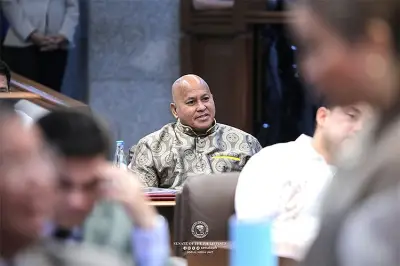
Those who have short memories—and there are many of you out there—here’s what happened during the short-lived “Bellum Cayetano.” It all started when Cayetano was elected Senate president on May 11, 2026, with the help of Sen. Ronald “Bato” dela Rosa. Dela Rosa was nowhere to be seen for at least six months when he suddenly emerged to play an instrumental role in the dramatic leadership shakeup that ousted Sen. Vicente “Tito” Sotto III and replaced him with Cayetano.
With him out in the open, the National Bureau of Investigation (NBI) tried to swoop in and arrest him on the basis of the arrest warrant issued by the International Criminal Court (ICC) over his alleged involvement in the crime against humanity charges in relation to the implementation of former President Rodrigo Duterte’s war against drugs. In an ideal world—oh who am I kidding, everything is far from ideal in this country—an elected public official should have no problem submitting himself to authorities. After all, no one is above the law. But then again, we’re talking about someone who had been evading arrest since last November.
So no one was surprised when the Cayetano leadership placed Dela Rosa under protective custody while he exhausted all his legal remedies against his apprehension. On the evening of May 13, a shooting happened inside the Senate building. The man behind it was then Senate sergeant-at-arms Mao Aplasca, who happened to be Dela Rosa’s classmate. Right before dawn of May 14, in the cover of darkness, Dela Rosa left Senate premises with Sen. Robin Padilla. For that caper, the Criminal Investigation and Detection Group has recommended charging Padilla with obstruction of justice.
After the Supreme Court denied Dela Rosa’s temporary restraining order against the ICC warrant, the Department of Justice issued an order on May 21 to the Philippine National Police and the NBI to arrest Dela Rosa. On June 3, Sen. Sherwin Gatchalian was elected as the Senate president pro tempore and acting Senate president after Cayetano ally Sen. Francis “Chiz” Escudero broke the majority bloc’s three-day boycott by attending the plenary session.
Despite this development, Cayetano’s fellow senator and sister, Pia Cayetano, who claimed to be the legitimate chairperson of the Senate Blue Ribbon Committee, pushed through with a hearing in relation to the panel’s probe into anomalous flood control projects with the so-called 18-ex marines as resource persons. Just when you thought things couldn’t get more dramatic, tensions flared when Department of the Interior and Local Government Secretary Jonvic Remulla allegedly tried to stop the resource persons from entering the plenary hall and he was pushed back by Padilla and several others.

Gatchalian’s leadership didn’t become official until June 17, when they achieved a quorum consisting of 13 lawmakers of the chamber following the attendance of Sen. Joel Villanova, another Cayetano defector—I mean, a former member of the Cayetano bloc. Does this mean the dust has finally settled? Of course not. This is the Philippines, after all. It’s very rare for political figures to give up and accept defeat, just like the Black Knight, that stubborn character from the film “Monty Python and the Holy Grail,” who refused to surrender despite having lost both arms and both legs.
But one thing is certain—or is it—the 28-day “Bellum Cayetano” is over. And after the credits rolled, a voiceover would pop up, “This program was brought to you by taxpayers of the Republic of the Philippines.” And all the while, Filipinos have to cope with rising costs and climate change.
Patronage survives because our institutions are patchy and poverty forces people to grab whatever lifeline is dangled in front of them. When information is uneven, short-term favors will always beat long-term policy in a voter’s calculation. Add a politicized civil service to the mix and you get a system that ruthlessly rewards loyalty over competence.
Fixing this isn’t rocket science. We need enforced campaign-finance rules, transparent spending portals to kill procurement scams, and a professionalized bureaucracy where appointments aren’t treated as patronage payoffs. But top-down reforms won’t stick unless citizens push back. We must demand audits, back local watchdogs, and finally stop treating basic public services as personal favors to be repaid at the ballot box.