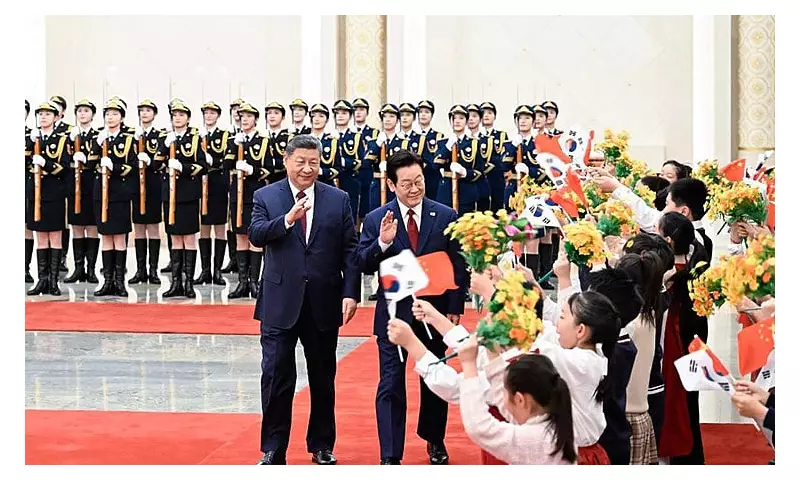
In a significant diplomatic engagement for the region, Chinese President Xi Jinping welcomed South Korean President Lee Jae Myung to Beijing on Monday, January 5, 2026. The state visit, Lee's first to China since taking office, featured high-level talks at the Great Hall of the People aimed at reinforcing the strategic cooperative partnership between the two Asian neighbors.
Strengthening the Strategic Foundation
During their discussions, both leaders emphasized the critical importance of the bilateral relationship. President Xi stated that China consistently prioritizes its ties with South Korea, maintaining a policy of continuity and stability. He expressed China's willingness to work with Seoul to uphold friendly cooperation, adhere to mutual benefit, and promote the strategic partnership on a healthy and stable path.
Xi underscored the need for both nations to enhance mutual trust, respect each other's development paths, and accommodate core interests and major concerns. He highlighted that differences should be resolved through dialogue and consultation.

President Lee Jae Myung responded by stating that South Korea hoped to use this first head-of-state meeting of the year to consolidate the momentum of bilateral relations. He emphasized a desire to seek common ground while reserving differences and to open a new chapter in ties. Notably, Lee affirmed that South Korea respects China's core interests and adheres to the One-China principle.
Experts like Dong Xiangrong from the Chinese Academy of Social Sciences noted that this top-level diplomacy sends a positive signal, guiding the relationship towards stronger political trust and economic cooperation.
Expanding Practical Cooperation in New Frontiers
A major focus of the talks was on deepening economic and practical collaboration. President Xi pointed to the deeply intertwined industrial and supply chains between the two economies. He called for aligning development strategies and strengthening policy coordination to achieve more results in emerging fields.
The leaders identified several key areas for future growth:
- Artificial Intelligence (AI) and technological innovation
- Green industries and ecological protection
- The silver economy related to aging populations
President Lee indicated that South Korea looks forward to seizing opportunities presented by China's upcoming 15th Five-Year Plan. The commitment was solidified immediately after the talks, as both leaders witnessed the signing of 15 cooperation documents covering sectors like scientific innovation, transportation, and trade.
Yang Xiyu, a researcher at the China Institute of International Studies, remarked that economic and trade cooperation has long been the stabilizing force in China-South Korea relations, a role it must continue to play.
Shared Responsibilities in Regional and Global Affairs
Beyond bilateral matters, the discussions also addressed shared regional and global responsibilities. President Xi stated that both countries, as beneficiaries of economic globalization, should oppose protectionism and uphold true multilateralism. He reminded that over 80 years ago, the peoples of both nations made sacrifices to win victory against Japanese militarism, and they must now work together to safeguard the outcomes of World War II and maintain peace in Northeast Asia.
President Lee concurred, expressing South Korea's willingness to strengthen multilateral coordination with China to contribute to global prosperity. He also extended wishes for China's success in hosting the 2026 Asia-Pacific Economic Cooperation (APEC) Economic Leaders' Meeting.
Analyst Dong Xiangrong added that in the face of renewed signs of Japanese militarism, China and South Korea share a common position in maintaining regional peace and jointly defending free trade.
The successful summit in Beijing marks a pivotal step in setting the tone for China-South Korea relations in 2026, with both sides committing to a future of enhanced partnership, practical cooperation, and shared strategic choices in the evolving geopolitical landscape.