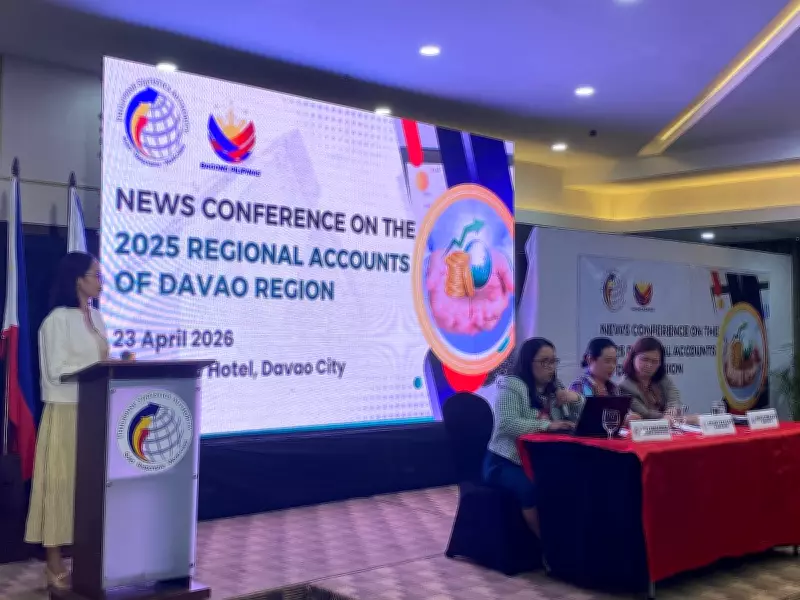
The Davao Region's economy surpassed the ₱1 trillion mark in 2025, demonstrating resilience despite earthquakes, extreme weather conditions, and governance concerns. During a news conference on April 23, 2026, at Apo View Hotel in Davao City, officials of the Philippine Statistics Authority (PSA) Davao Region presented the 2025 Regional Accounts, revealing that the region's gross regional domestic product (GRDP) reached ₱1.14 trillion at constant 2018 prices.
Growth Amid Challenges
Baby Jean P. Alid, officer-in-charge of the Regional Statistical Services Office 11, stated that the growth was achieved despite significant challenges. These included double earthquakes, weather disturbances, and governance issues. The region's economy grew by 5.1 percent in 2025, slower than the 6.3 percent expansion recorded in 2024. However, the Davao Region ranked as the fourth fastest-growing economy among 18 regions and the fifth largest, accounting for 4.9 percent of the country's gross domestic product.
Sectoral Performance
The services sector remained the primary growth driver, accounting for 62.1 percent of total output and expanding by 6.9 percent. Its gross value rose to ₱707.15 billion in 2025, up from ₱661.52 billion in 2024 and ₱619.74 billion in 2023. Industry made up 24.7 percent of the economy and grew 2.7 percent, with output increasing to ₱281.01 billion from ₱273.74 billion in 2024. Agriculture, forestry, and fishing accounted for 13.2 percent and expanded 1.9 percent, with gross value reaching ₱149.68 billion in 2025, rebounding from ₱146.90 billion in 2024.

Key Industries
Public administration and defense, including compulsory social security, led industry growth at 13.4 percent. Human health and social work activities grew by 9.8 percent, while transportation and storage expanded by 8.2 percent. These figures reflect stronger government activity, sustained healthcare demand, and improved mobility across the region.
Expenditure and Per Capita GDP
On the expenditure side, imports surged 18.7 percent, followed by spending on valuables at 16.8 percent. Exports also rose 11 percent, signaling stronger trade engagement. Per capita GDP increased from ₱188,571 in 2023 to ₱206,727 in 2025, reflecting a 5.3 percent rise in 2024 and a 4.1 percent increase in 2025. This indicates higher average economic output per resident.
Challenges and Resilience
Strong earthquakes and recurring weather disturbances disrupted economic activity in 2025. These events damaged infrastructure, affected agriculture and transport, and strained public resources, particularly in vulnerable communities. Concerns over infrastructure and flood control projects also drew public attention, with reports raising questions about the effectiveness, quality, and transparency of flood mitigation efforts, especially in flood-prone areas.
Despite these challenges, the Davao Region's diversified economy helped sustain growth. The dominance of services, coupled with steady industry output and recovering agriculture, provided a buffer against external shocks. Increased government spending, stronger trade flows, and continued domestic demand also contributed to maintaining economic momentum.