Olango Island Shell Artisans Face Rising Costs While Preserving Generational Craft
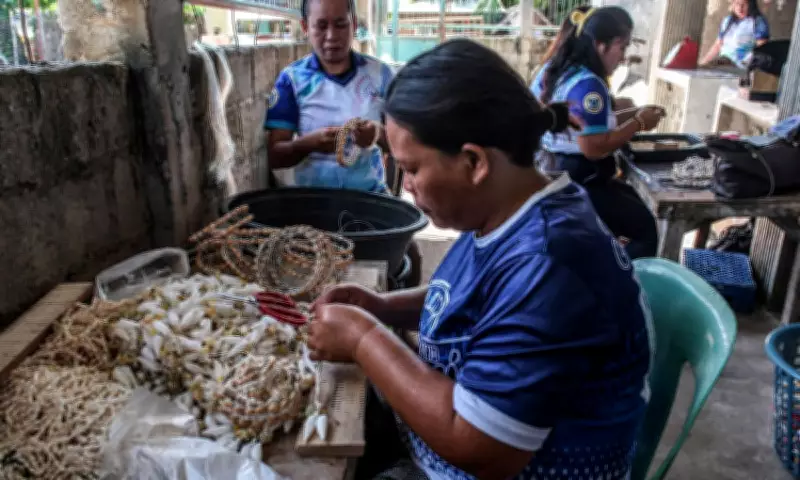
In Barangay Sabang on Olango Island, located within Lapu-Lapu City, mornings unfold not to the sounds of urban commotion but to the gentle clatter of seashells being poured onto wooden worktables. For 50-year-old Analy Bacante, this auditory backdrop of shells being drilled, roasted, and polished has been the soundtrack of her life for nearly three decades.
A Legacy of Precision and Patience
As a second-generation artisan, Bacante learned the intricate craft from her parents, who initially created simple placemats from shells collected by local fisherfolk. Today, she elevates these oceanic treasures into exquisite chandeliers and necklaces that journey from Cebu to international markets in the United States and China. However, behind the delicate glow of a shell chandelier lies a labor-intensive three-day process, now increasingly strained by escalating raw material costs and shrinking profit margins.
The Three-Day Transformation Process
Each shell arriving at Bacante's modest home workshop undergoes a rigorous preparation phase. Women from the neighborhood labor from 8 a.m. to 5 p.m., manually drilling holes into freshly delivered shells before roasting them—known as "sangag" in Cebuano—for approximately 30 minutes until they achieve a warm brown hue.

The subsequent step, once a day-long ordeal of manual polishing, was revolutionized in 2025 by a small motorized tumbler. Now, shells spin in a makeshift barrel with sulfuric acid for about an hour, emerging shinier and prepared for sun-drying. "It's a big help," Bacante remarked in an interview with SunStar Cebu, highlighting how the machine enhanced both efficiency and quality.
After drying under the island sun for a full day, the shells are finally ready for assembly. From collection to production-ready material, this meticulous preparation alone consumes three full days.
Financial Strains and Market Challenges
Despite this painstaking craftsmanship, finished chandeliers sell for modest prices ranging from P150 to P1,200. A 32-centimeter colored design fetches P150, a 48-centimeter brown piece sells for P200, and an 88-centimeter chandelier—which can take days to assemble—may reach P1,200. While retail prices in souvenir shops are higher, artisans receive only a fraction of that markup.
The challenges intensified following the Covid-19 pandemic and Typhoon Odette (Rai). Operations halted during lockdowns, and finished products suffered damage during the typhoon. Material costs have since doubled, rising from P70-P80 per kilo to P160, with stringing materials increasing from P32 to P70.
"Dako na kaayo ang puhunan (The capital involved is already very big)," Bacante explained. Capital requirements now reach at least P100,000 to fulfill bulk orders—a sum far beyond what many artisans can readily afford. Before the pandemic, buyers often provided advance payments, but that practice has ceased, forcing artisans to shoulder production costs upfront. Consequently, many orders from Punta Engaño, Mactan, Talisay City, and export markets must be declined due to limited capital.
Community Support and Supply Dynamics
The City Government of Lapu-Lapu previously allocated P50,000 per barangay to help revive the industry during the administration of then-mayor Junard "Ahong" Chan, but Bacante emphasized that additional support is necessary to sustain the trade. She is part of the Ako-Babae Federation, a women's association organized through the City Social Welfare and Development Office, spanning 11 barangays across Olango Island.
"As production slowed, fewer orders came in," Bacante stated in Cebuano. "Problema pud mi kay dako na kaayo ang puhunan, kinahanglan gyud mi og dako na kantidad kay ang materyales grabe kasaka (We're also facing a problem because the investment is already very large. We really need a bigger amount now because the cost of materials has increased drastically)."

Shell Supply and Economic Impact
Shell supply follows the rhythmic patterns of the sea. Local varieties like sungasig and aninikad are sourced nearby, while nasa and sigay shells arrive from Bohol, Masbate, Zamboanga, and Bantayan. Supply peaks from February to July, depending on sea conditions, with production strongest from May to October before slowing as December approaches.
On productive days, the group can manufacture up to 200 pieces daily. Monthly earnings average over P10,000—a modest yet vital income that covers essential expenses like food, electricity, and school fees. Bacante credits shellcraft for enabling her to support her family, with one child already graduated and another in third-year college.
A Fragile Cultural Inheritance
The business originated with Bacante's parents and expanded in 2000 after her marriage, when she ventured into higher-value products like chandeliers. Yet uncertainty looms over whether her children will continue the craft, given its demanding nature and thin margins. Climate change further threatens shell supply, while natural disasters can devastate inventory overnight.
Nevertheless, Bacante maintains faith that the craft will endure—provided capital flows and markets remain accessible. In Olango, where livelihoods ebb and flow with the tides, shellcraft transcends mere souvenir production. It represents women's labor, family sustenance, and cultural heritage shaped by patience and salt air.
As long as shells continue to wash ashore and skilled hands remain willing to thread them into light, the glow from Sabang's chandeliers will carry stories far beyond the island's shores, preserving a generations-old tradition against the challenges of rising costs, natural disasters, and an uncertain future.