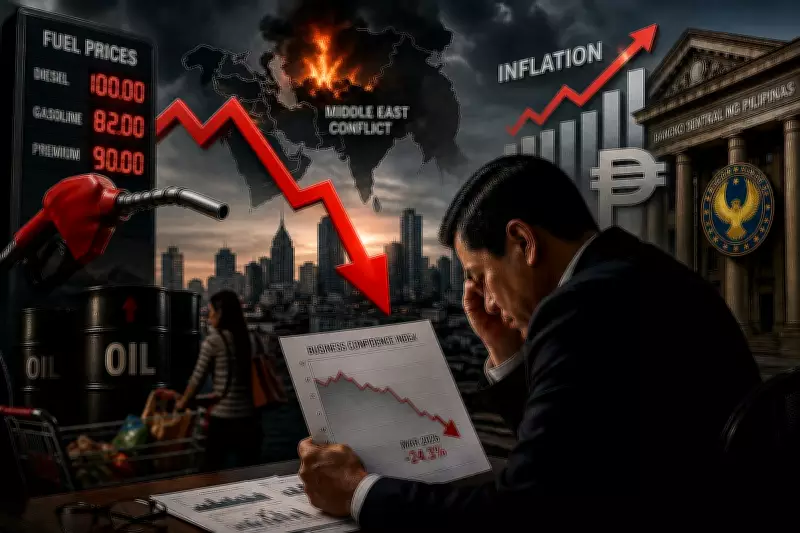
Business confidence in the Philippines turned pessimistic in March 2026, as rising fuel costs linked to the Middle East conflict dampened optimism among firms, according to the Bangko Sentral ng Pilipinas (BSP). The central bank's Business Expectations Survey (BES) revealed that the confidence index (CI) for the current month plunged to negative 24.3 percent from 8.2 percent in February. A negative CI indicates that more firms are pessimistic than optimistic about business conditions.
Sharp Decline in Near-Term Outlook
The outlook for the next quarter also weakened sharply, with the three-month-ahead CI dropping to negative 17.3 percent from 37.4 percent in the previous survey. The BSP attributed this decline to concerns over higher fuel prices, which are expected to feed into the cost of goods and services and slow consumer spending. Firms cited inflationary pressures and weaker consumer spending expectations as key factors weighing on sentiment.
Long-Term Optimism Fades
Despite the near-term pessimism, firms remained optimistic over the next 12 months, although confidence eased significantly. The year-ahead CI declined to 11.7 percent from 51.1 percent, weighed down by uncertainty over prolonged geopolitical tensions and persistent inflation pressures. The BSP noted that businesses continue to face headwinds from the Middle East conflict, which has kept oil prices elevated.

Labor Market and Investment Plans
Businesses also signaled softer labor demand. Hiring intentions for both the next quarter and the year ahead turned less favorable, pointing to subdued employment growth in the coming months. However, a higher share of industry firms reported expansion plans, indicating that some investments will proceed as these were already in the pipeline before the escalation of the Middle East conflict.
Inflation Expectations Rise
Inflation expectations among businesses trended higher. Firms expect inflation to rise above the BSP's 3 percent target in the coming months, although forecasts remain within the central bank's tolerance band of plus or minus 1 percentage point. The BSP said it continues to monitor the impact of global oil price movements on domestic inflation and economic activity.
Policy Response
The BSP added that it stands ready to take appropriate monetary policy action if price pressures become more persistent. To cushion the impact on borrowers, the central bank has also issued regulatory relief measures allowing banks to extend assistance to affected clients. The BES, a monthly survey of firms nationwide, provides advance indications of business activity and serves as a key input to the BSP's monetary policy decisions.