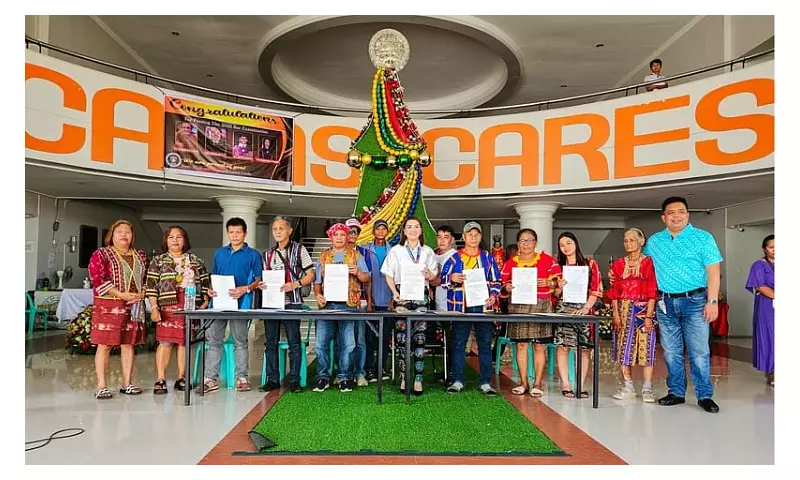
In a significant stride for sustainable development, the Provincial Government of Davao del Sur has forged a major partnership to transform the iconic Mt. Apo into a premier agri-ecotourism destination while securing a priceless cultural legacy. The dual ceremony, held on January 12, 2026, marks a pivotal moment for the province's economic and cultural landscape.
A Dual Commitment to Heritage and Development
Led by Governor Yvonne Cagas and Vice Governor Marc Cagas, the provincial government executed a landmark Memorandum of Agreement (MOA) for the development of the Mt. Apo Agri-Ecotourism Park in Barangay Kapatagan, Digos City. The agreement was signed in partnership with the Mount Apo Bagobo-Tagabawa Ancestral Domain Inc. (MABATADI) and the National Commission on Indigenous Peoples (NCIP).
Simultaneously, in a profound gesture of trust and cultural preservation, the Bagobo-Tagabawa Tribal Council formally donated 11 traditional cultural artifacts to the province. These items will be permanently housed and displayed at the Davao del Sur Provincial Museum, ensuring their protection and public appreciation for generations to come.

Building a Community-Led Ecotourism Model
The MOA for the Mt. Apo Agri-Ecotourism Park is founded on principles of community participation and equitable benefit-sharing. This model ensures that the indigenous communities, who are the ancestral guardians of the land, are active leaders and primary beneficiaries of the tourism initiative.
During the signing, Vice Governor Marc Cagas emphasized the inclusive nature of the project, stating, "Our joint endeavor will not only benefit the provincial government but your respective IP communities as well. Through an ordinance, the provincial government will provide incentives to your end. Good things await for you." This approach positions the park as a national benchmark for responsible and inclusive ecotourism.
Preserving a Living Cultural Heritage
The donation of the 11 artifacts is not merely a transfer of objects but a strengthening of cultural continuity. The pieces, which include traditional tools, garments, and ceremonial items, are a tangible connection to the rich heritage of the Bagobo-Tagabawa people, particularly from the Cultural Village in Barangay Tibolo, Sta. Cruz.
The turnover ceremony, supported by the Provincial Tourism Development and Culture Promotions Office (PTDCPO) and Dr. Sheruel G. Matalandag of Davao del Sur State College, ensures these artifacts will be preserved and interpreted according to community values. This act serves to educate visitors and residents alike, fostering deeper cultural awareness and pride.
Boosting Grassroots Livelihoods
Complementing the long-term tourism and cultural projects, the provincial leadership also distributed substantial livelihood assistance to local associations on the same day, demonstrating an integrated development strategy:
- Farmers Association of Lower Marber (FALOMA): ₱800,000 for farm input and supply support.
- Purok San Francisco Livelihood Association (PUSANFLA): ₱300,000 to establish a retail income-generating hub.
- Barangay San Miguel, Digos City: A computer set with printer worth ₱50,000.
- Barangay San Pedro, Kiblawan: A computer set with printer and a brush cutter worth ₱79,000.
These grants are designed to build digital and agricultural capacity at the barangay level, creating a stronger economic foundation that will synergize with future tourism opportunities.
The Path Forward for Sustainable Tourism
The convergence of these initiatives—ecotourism development, cultural conservation, and livelihood support—creates a powerful blueprint for holistic growth. By centering the Bagobo-Tagabawa community in the stewardship of Mt. Apo, the project safeguards both the mountain's fragile ecosystem and the living culture of its people.

This model promises to attract conscientious travelers seeking authentic experiences, thereby generating sustainable income streams for local guides, artisans, and farmers. The January 12 agreements ultimately represent more than just plans on paper; they are a committed step toward a future where progress honors both the environment and heritage.