Agricultural Cooperatives: A Vital Shield for Philippine Food Security
In the face of mounting global and climatic challenges, agricultural cooperatives are increasingly recognized as essential buffers against food insecurity in the Philippines. Rising fuel prices, linked to escalating tensions in the Middle East, and the impending El Niño phenomenon pose significant threats to agricultural production and supply chains across the nation. This critical issue took center stage during the Knowledge and Learning, Innovations, and Trade Expo, held from April 15 to 17, 2026, in Cebu City. Organized by the Philippine Family Farmers Agriculture Fishery Forestry Cooperative Federation (AgriCOOPh), the event brought together government officials, cooperative leaders, and development partners to advocate for robust systems that can protect farmers and consumers from economic and climate-related shocks.
Government Support and Local Vulnerabilities
Governor Pamela Baricuatro voiced strong support for the initiative, emphasizing the pivotal role of cooperatives in fortifying food systems. Meanwhile, Cebu City Mayor Nestor Archival underscored the urgency of food security, highlighting a stark vulnerability: approximately 65 percent of the city's food supply is sourced from outside Cebu, making it highly susceptible to disruptions. He issued a stark warning, stating, "If there is a disaster in the next month, we will have no food to eat," which underscores the pressing need for localized resilience.
Addressing Rising Input Costs and Promoting Self-Reliance
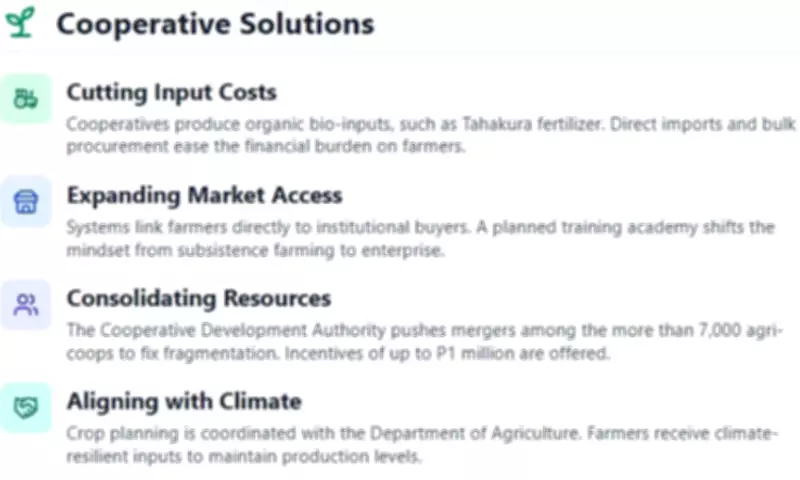
Irish Baguilat of the Asian Farmers' Association pointed out that small-scale farmers are grappling with escalating input costs, particularly for fertilizers. However, she noted that local initiatives, such as organic and low-input fertilizer production, offer practical solutions. Baguilat cited examples like Tahakura fertilizer, which can be scaled up to reduce expenses and enhance self-sufficiency. She emphasized that cooperatives play a crucial role in consolidating produce and connecting farmers directly with buyers, thereby diminishing dependence on traditional markets. "I think while we are facing the challenge, we can see it as also an opportunity for the initiatives of agri-coops in the Philippines to really get the attention they need and to be valued," Baguilat remarked.

Enhancing Market Access and Shifting Mindsets
AgriCOOPh chairman Edelito Sangco detailed ongoing efforts to lower production costs and expand market access. Plans include direct imports of fertilizers, such as nano-urea, through partnerships with international cooperatives, especially in India. Sangco warned of an expected spike in fertilizer prices due to current crises, advocating that bulk procurement could mitigate these costs. Additionally, he highlighted strengthened links to government procurement and institutional buyers, alongside initiatives to transition farmers from subsistence to enterprise-oriented models. "The mindset needs to be transformed from just farming for consumption to farming for business purposes," Sangco stated, mentioning plans for a training academy in collaboration with the Technical Education and Skills Development Authority.
Consolidation and Ecosystem Development
The Cooperative Development Authority (CDA) is actively promoting consolidation among agricultural cooperatives to optimize resources and reduce expenses. CDA Assistant Secretary Luz Yringco noted that fragmentation remains a major issue, despite the existence of over 7,000 agricultural cooperatives nationwide. To address this, incentives of up to P1 million are being offered for mergers to achieve economies of scale. Yringco also discussed the development of an "agri-cooperative ecosystem" designed to streamline government support and foster partnerships with private firms, including mobile store logistics, to bring products closer to markets. "We are teaching the farmers to produce, sell it and, most importantly, if they have federated, they sell it to the federation that will take care of the marketing side," she explained.

Climate Adaptation and International Collaboration
Officials stressed the importance of aligning agricultural production with climate conditions, particularly in anticipation of El Niño's impacts. Yringco called for closer coordination with the Department of Agriculture to facilitate crop planning and access to climate-resilient inputs. Reinhold Hoernle, project director of Deutscher Genossenschafts-und Raiffeisenverband e.V. (DGRV), a German cooperative and banking confederation, affirmed the enduring relevance of cooperatives during crises, rooted in principles of collective action and resource sharing. DGRV, which serves as the national apex and auditing association for Germany's cooperative sector, is implementing a project in the Philippines funded by the German Federal Ministry for Economic Cooperation and Development. This initiative aims to provide consultancy and develop sustainable cooperative structures. "It means joining hands, producing together, buying in bulk and helping each other," Hoernle concluded, encapsulating the cooperative spirit driving these efforts forward.