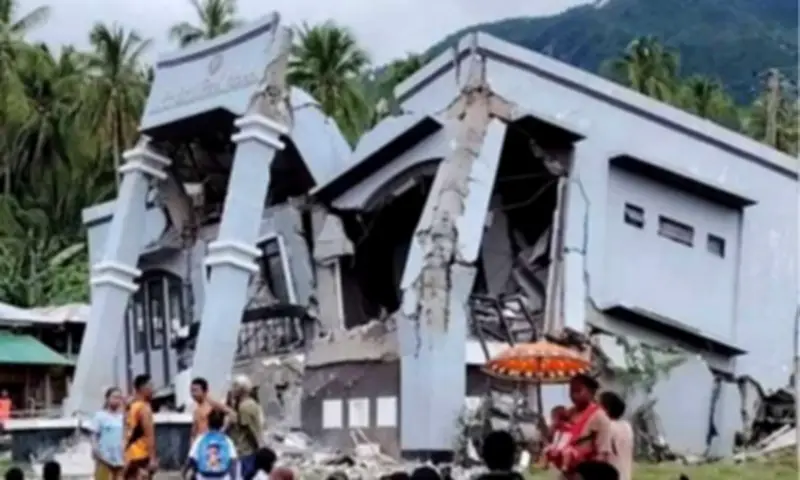
The Regional Disaster Risk Reduction and Management Council of the Davao Region (RDRRMC-Davao) reported that as of 10:30 a.m. on June 15, 2026, the death toll from the magnitude 7.8 earthquake that struck off the coast of Maasim, Sarangani, on June 8, 2026, has reached 10. Additionally, 78 individuals were injured and 19 remain missing across the region.
Latest Updates from Kapehan sa Dabaw
Regional authorities convened on Monday morning, June 15, 2026, at SM City Davao Annex in Ecoland, Davao City, for Kapehan sa Dabaw to provide the latest updates on the ongoing response to the disaster. The earthquake has affected thousands of families and left communities in Davao Occidental still cut off from aid.
Affected Population and Damage
A total of 112,616 persons in 106 barangays were affected, with 30,040 families displaced. Among them, 648 families are sheltering inside three evacuation centers—one in Kiblawan and two in Sarangani—while seven families remain outside. Infrastructure damage has reached ₱141,679,000, with 7,029 houses damaged, of which 2,650 were destroyed.

Government Response and Monitoring
Department of the Interior and Local Government-Davao Region (DILG-Davao) Director Abdullah V. Matalam said local government units have been actively monitoring developments on the ground. "At the ground level, we have what we call a situational report, or sitrep, every six hours. We are reporting to the DILG," he said, adding that they are also closely monitoring the situation in Davao Occidental and providing assistance to affected communities.
Office of Civil Defense Davao Region (OCD-Davao) Director Ednar Dayanghirang raised concern over a body of water that had accumulated and formed a dam-like barrier between Barangay Molmol and Barangay San Isidro in Jose Abad Santos—one of the three barangays still isolated and inaccessible for relief operations, alongside Quiapo. Dayanghirang outlined three possible solutions: releasing the water, installing a drain on the side of the river, or laying pipes to redirect it so that digging up the earth would no longer be necessary. He expressed hope that a final decision would be reached by Monday evening.
Aftershock Activity
Philippine Institute of Volcanology and Seismology (Phivolcs) representative Bong Lauron reported on the aftershock occurrence rate (AOC)—a metric used by Phivolcs to track the frequency of aftershocks since the mainshock. As of June 14, the agency had recorded more than 5,200 aftershocks ranging from magnitude 1.2 to 6.4, with only 76 classified as "felt" by the public. Aftershocks are expected to continue for several days to weeks.
Inaccessible Barangays and Relief Operations
Three barangays in Jose Abad Santos—Molmol, San Isidro, and Quiapo—remain inaccessible, while Barangay Nuing and Barangay Butuan, also in the same municipality, have been confirmed to have completed evacuation. The Department of Social Welfare and Development in Davao Region (DSWD-Davao) said aerial operations are ongoing, with 600 family food packs (FFPs) being delivered to five sitios in Jose Abad Santos: Kidaman, Makina, Kawayan, Pasakan, and Pikong. The agency is targeting the delivery of 40,000 food packs to Jose Abad Santos within this week.
Management of the Dead and Missing
The DILG is also coordinating the Management of the Dead and Missing (MDM) protocol, prioritizing the release of information and assistance to affected families, including the issuance of death certificates and other necessary documents. If the missing cannot be identified, the National Bureau of Investigation (NBI) will take over, after which the remains will be given temporary burial, and the local government unit will provide free legal documents, including death certificates, to the families.
Humanitarian Assistance
Total humanitarian assistance provided has reached ₱29,673,506.57, broken down as ₱27,673,506.57 for families and ₱2,000,000 for local government units and agencies.