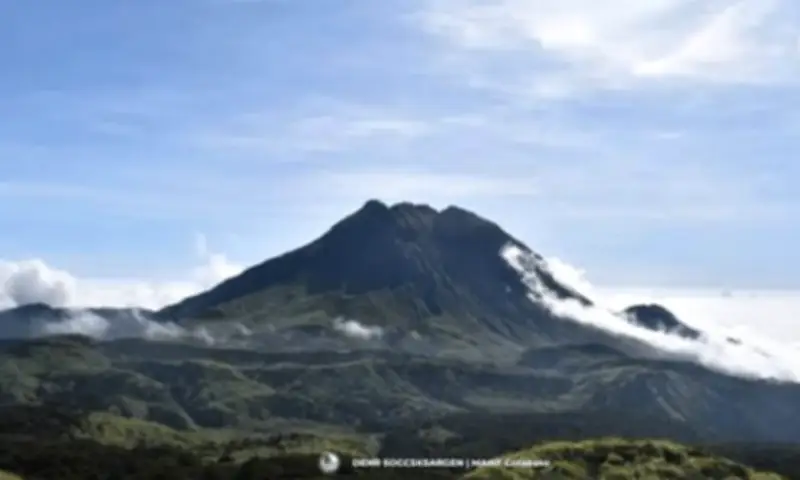
The Department of Environment and Natural Resources-Davao Region (DENR-Davao) is confident that Mt. Apo National Park (MANP) will be included in the UNESCO list of Global Geoparks. Clint Michael B. Cleofe, Protected Area Superintendent of MANP, announced that the park is in its second year of preparation and hopes the application will succeed, making Mt. Apo the second Philippine site after Bohol to receive this designation.
Previous Attempt and Environmental Challenges
In 2009, Mt. Apo was nominated for UNESCO World Heritage status, but due to environmental degradation—including illegal logging, wildlife poaching, and urban and agricultural expansion—UNESCO removed it from the tentative list in 2015. Despite this setback, the current bid focuses on the Global Geopark program, which emphasizes geological significance and sustainable management.
“We are always optimistic and sincerely hopeful that the outcome of today's evaluation will be positive. We hope the evaluation will be successful and that our score will be sufficient for us to be included and recognized as a UNESCO Global Geopark,” Cleofe said in a media interview on July 10, 2026, in Barangay Kapatagan, Digos City.

Evaluation Process and Timeline
Cleofe shared that MANP submitted its application in 2025, and UNESCO has evaluated it. From August 16 to 21, 2026, coinciding with the Kadayawan Festival, two evaluators—a senior evaluator from France and a junior evaluator from China—will visit the area. They will assess how MANP operates as a Global Geopark aspirant and its care in coordination with Indigenous Communities (ICs) living in the protected area.
During the evaluation, stakeholders including local officials from Davao City, Davao del Sur, and Cotabato will participate. The evaluators will visit volcanic origin sites within MANP and examine the participation, customs, and daily significance of the mountain for IPs. UNESCO places importance on Mt. Apo as a sacred place for Indigenous Peoples.
Potential Delays and Local Support
Cleofe acknowledged that the proclamation could be delayed if DENR-Davao has not yet implemented required activities. However, he emphasized that securing the bid would be a huge source of pride for Mt. Apo and all Dabawenyos.
Local government units have expressed support. Davao City passed City Ordinance No. 0472-24, declaring Mt. Apo a geological monument and supporting the UNESCO bid. The Municipality of Sta. Cruz also supports the measure, citing Mt. Apo’s boulder face as a major geological feature. Under Republic Act No. 9237 (Mount Apo Natural Park Act), the protected area spans Davao City, Digos City, Kidapawan City, and the municipalities of Sta. Cruz, Bansalan, Makilala, and Magpet. These LGUs participate in area management through the Protected Area Management Board (PAMB).
UNESCO Global Geopark Program
According to UNESCO, a Global Geopark is a unified geographical area where sites of international geological significance are managed through a holistic approach to protection, education, and sustainable development. As of 2026, there are 241 sites in 51 countries, including Hong Kong Global Geopark, Mount Rinjani in Indonesia, Aso Geopark in Japan, and Vulkaneifel in Germany. In the Philippines, only Bohol is listed, known for its karst formations and Chocolate Hills.
MANP was declared a protected area under the National Integrated Protected Areas System (NIPAS) Act (Republic Act No. 7586) on June 1, 1992, by former President Corazon C. Aquino. The park hosts 800 types of flora, with 27 species having economic, cultural, and medicinal significance. It also has 272 bird species and 54 mammal species, including the Philippine Eagle. Of 414 faunal species, 207 are endemic to MANP, and 146 faunal species and 27 floral species have economic and medicinal value.