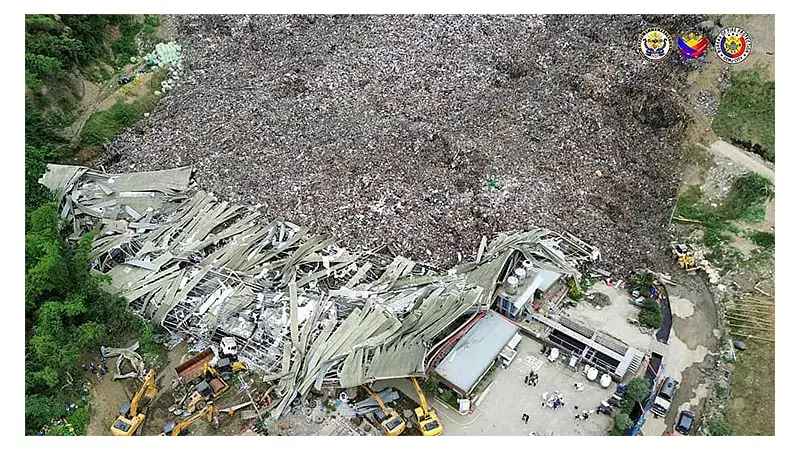
A catastrophic landslide at a major landfill has plunged Cebu City into a dual crisis of humanitarian tragedy and a looming garbage disposal emergency. The incident at the Prime Waste Solutions Cebu Landfill in Barangay Binaliw has claimed lives, left dozens missing, and paralyzed waste collection for three cities.
Immediate Aftermath and Rescue Operations
The collapse occurred shortly after 4 p.m. on Thursday, January 8, 2026, forcing an immediate halt to all dumping activities. The suspension created an instant logistical gridlock, with garbage trucks stranded full and unable to unload. City Councilor Joel Garganera confirmed that collection services are paralyzed and appealed to residents to temporarily keep their trash at home.
The human cost is severe and still unfolding. Three individuals have been confirmed dead, while more than 30 people remain missing, trapped under the debris. Search and rescue teams are working around the clock, with the critical rescue phase scheduled to continue until January 11, after which operations will shift to retrieval.

Region-Wide Waste Disposal Crisis
The disaster's impact extends far beyond Cebu City's borders. The Binaliw facility also serves Mandaue City and Lapu-Lapu City, creating a metropolitan-wide garbage crisis. Mandaue City Mayor Thadeo Jovito “Jonkie” Ouano suspended his city's garbage collection on Friday and is now coordinating with Governor Pamela Baricuatro to find a unified solution for the affected local government units (LGUs).
With 500 to 600 tons of waste generated daily with nowhere to go, Cebu City is urgently seeking a temporary dumping site. Mayor Nestor Archival is proposing a 15-day agreement with other landfill operators. Potential sites in Consolacion and Minglanilla have been identified, but the host LGUs have not yet agreed. The city has formally requested the Department of Environment and Natural Resources (DENR) 7 to facilitate talks and issue special permits for the emergency transfer.
Criticism and Long-Term Solutions
Environmental group Greenpeace has drawn a stark parallel between this disaster and the Payatas landfill tragedy in Quezon City 25 years ago. Campaigner Marian Ledesma condemned the event as a symptom of a “broken waste management system” and a failure to fully enforce the Ecological Solid Waste Management Act of 2000.
The group argues that the overproduction of residual waste and single-use plastics makes landfills inherently unstable. They contend that without a ban on such plastics and strict source segregation, local governments remain vulnerable to catastrophic collapses, despite operators like Prime Waste Solutions Cebu having claimed the site had a remaining lifespan of three to four years.
As a future measure, Cebu City plans to implement stricter waste diversion, aiming to separate 300 tons of biodegradables daily to reduce pressure on any new disposal site. For now, the immediate focus remains on the rescue mission and the critical test of inter-LGU cooperation in the coming days to avert a full-blown public health crisis.