Environmental advocates in Davao City are urgently promoting a shift to a circular economy model, a systemic change seen as critical to managing the city's escalating waste problem and ensuring the longevity of its sanitary landfill.
Local Champions of the Circular Model
Lemuel Manalo, program coordinator of the environmental group Interfacing Development Interventions for Sustainability (IDIS), emphasized that the push for a circular economy is a direct response to a national waste crisis and the global climate emergency. He explained that this model, which designs waste out of the system and keeps materials in use, aligns with the United Nations Development Programme's (UNDP) goals to cut greenhouse gas emissions, notably from landfills.
Manalo pointed out that while the term may seem new, the practice is already alive in Davao. "Many existing practices in Davao City already reflect it such as ukay-ukay sellers, thrift shops, and repair businesses," he said. He encouraged public support for this sector, which often involves marginalized communities.

Transforming Trash into Treasure
One standout example is the Toril Kalambuan Association, founded in 2011 by Elena Mabano. This group creatively upcycles plastic waste like snack wrappers, milk packs, and detergent sachets into fashionable bags, wallets, and accessories. Mabano shared that despite early struggles and low profits, their passion for protecting the environment drives them forward.
"But because our hearts are already full of passion to continue protecting the environment, even in small ways our contribution becomes significant," Mabano stated during a media tour on December 3, 2025.
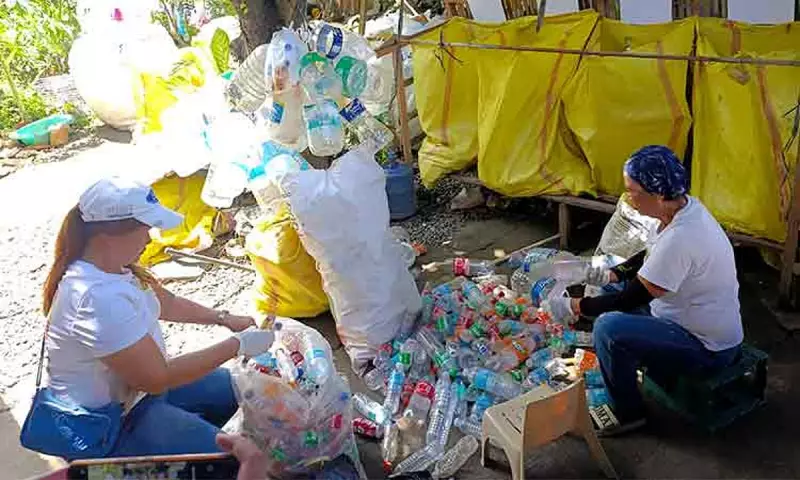
Another group, the Mintal Resource Collectors' Association (MiRCA), composed mostly of women, focuses on collecting recyclables from communities to sell to junk shops. Divina Morales of MiRCA noted their profit is minimal, but the primary goal is environmental: to reduce waste heading to the landfill.
Innovative Solutions for Organic Waste
Beyond plastics, innovative solutions are tackling food waste. Apo Natural Farms in Barangay Tacunan and the group Limadol utilize black soldier fly (BSF) larvae. These harmless, native insects rapidly consume food waste, preventing it from reaching landfills, reducing emissions and odors, and contributing to food security and livelihoods.
Davao's Unsustainable Waste Reality
The advocacy for a circular economy is underscored by a pressing reality. According to IDIS, Davao City's sanitary landfill in New Carmen, Tugbok District, became full in just 10 years—half its intended 20-year lifespan—because of the dumping of compostables and mixed waste instead of only residual waste as mandated by law.
Data from the City Environment and Natural Resources Office (Cenro) reveals a sharp increase in daily waste collection. From about 400 tons per day in 2010, it has ballooned to between 700 to 800 tons per day in late 2024 and early 2025. For August 2025 alone, the city collected an average of 798 tons daily, all sent to the landfill.
In response, the local government has budgeted over ₱500 million for a two-phase landfill expansion to meet environmental standards. It is also considering a Waste-to-Energy (WTE) facility, a project that has raised concerns among local environmental groups about potential health and environmental risks.
On the barangay level, compliance with waste segregation infrastructure is mixed. Of Davao's 182 barangays, 53 have Materials Recovery Facilities (MRFs), 116 operate Materials Recovery Stations (MRS), and 47 have composting facilities.
The Global Imperative for a Circular Shift
The UNDP defines a circular economy as a system aimed at reducing waste and sustainably using resources through smarter design, longer use, recycling, and regenerating nature. The agency warns that if current consumption trends continue, resource demand by 2050 would require the equivalent of three planets Earth.

For Davao City, the path forward is clear. The grassroots efforts of associations like Toril Kalambuan and MiRCA, coupled with innovative bio-solutions and a systemic policy shift, are vital steps toward diverting waste from the overwhelmed landfill and building a more sustainable, circular future for all Dabawenyos.