Duterte's Defense Lawyer Levels Explosive Allegations Against Marcos Administration
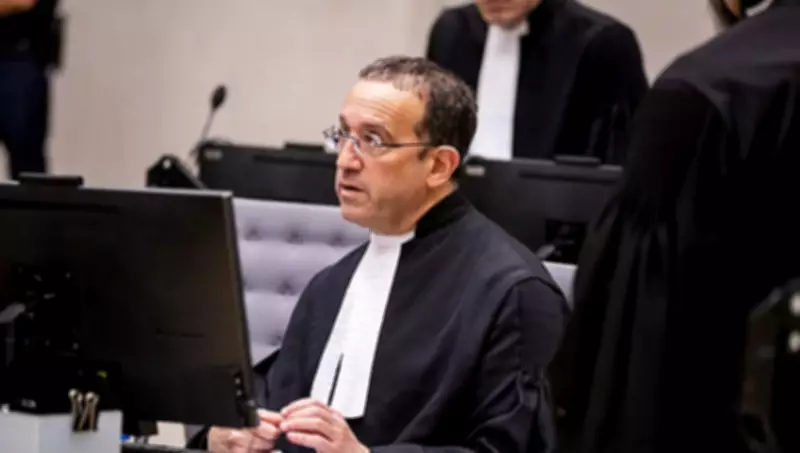
In a dramatic opening statement at the International Criminal Court, Nicholas Kaufman, legal counsel for former Philippine President Rodrigo Duterte, launched scathing accusations against the administration of President Ferdinand Marcos Jr., alleging a coordinated effort to undermine his predecessor through witness manipulation in the high-profile drug war case.
Allegations of Political Neutralization
During the first day of confirmation of charges proceedings on February 23, 2024, Kaufman presented what he described as evidence of a scheme to influence witnesses in the ICC case against Duterte. The defense lawyer cited a transcript of a telephone conversation between four unidentified individuals, where one participant allegedly boasted about acting as a "silent partner" to President Marcos.
"One of these parties was boasting about how he was acting as the silent partner of President BBM (Marcos), managing a scheme to funnel witnesses to this court while all the time ensuring that he could guarantee President BBM's plausible deniability," Kaufman told the ICC Pre-Trial chamber.

The defense attorney argued this demonstrated that "President Marcos Jr. set out to neutralize Rodrigo Duterte and his legacy," contradicting earlier promises not to assist the ICC in bringing charges against the former leader.
Defense Challenges Prosecution's Case
Kaufman urged the court to dismiss what he called "grievously misplaced and politically motivated" charges against the 80-year-old former president. He maintained that Duterte "absolutely maintains his innocence" and stands firmly behind his record despite what he characterized as "wholly insufficient" evidence.
The defense lawyer criticized the prosecution for allegedly "cherry-picking" statements from Duterte's speeches while ignoring other remarks where he emphasized respect for the rule of law. Kaufman argued that Duterte's tough-talking rhetoric represented "hyperbole" intended to instill fear in criminals rather than direct orders to kill.
"His rhetoric was calculated to arouse fear and obedience, to instill fear in their hearts and to inculcate a respect for the law in their minds. Nothing more, nothing less," Kaufman asserted.
Specific Charges and Defense Counterarguments
The ICC prosecution has charged Duterte with multiple crimes spanning his political career:
- Murders in Davao City between 2013 and 2016 allegedly involving the Davao Death Squad, with 19 victims including three children
- Murders of high-value targets during his presidential term from 2016 to 2017 involving 14 victims
- Murders and attempted murders during barangay clearance operations from 2016 to 2018 covering 45 victims
Kaufman dismissed the concept of the "Davao Death Squad" as a "fictitious construct" and argued that Duterte's leadership in both Davao City and nationally reflected law-and-order success rather than criminal conduct.
The defense attorney further challenged the prosecution's methodology, stating: "We will also convince you that as hard as they try, the prosecution's investigators could not get even one of its criminal cooperating witnesses to admit that they heard the former President Rodrigo Duterte give an order to kill."
Prosecution's Position and Statistical Claims
ICC Deputy Prosecutor Mame Mandiaye Niang presented a contrasting narrative in his opening statement, arguing that Duterte played a "pivotal role" in "widespread and systematic attacks" against civilians during his drug war campaign. The prosecution used Duterte's own words about killing drug lords as evidence of his authorization of violence.
Kaufman countered with statistical claims, asserting that "the death rate flowing from narcotics-related crime actually increased after Rodrigo Duterte left power." He emphasized that "cases are decided on the basis of evidence, not supposition, not rumor, not spicy gossip and certainly not on the basis of political rhetoric and bluster."

Palace Rebuttal and Timeline Dispute
In a swift response, Palace press officer Undersecretary Claire Castro strongly rejected Kaufman's allegations against the Marcos administration. "Kaufman has the temerity to accuse President Marcos of trying to neutralize Duterte's legacy. That is preposterous," Castro stated.
The Palace official challenged the defense lawyer's timeline, noting that "the crimes against humanity cases were filed before the International Criminal Court in 2017, when President Marcos Jr. was still a private citizen."
Castro further referenced previous statements by another Duterte counsel, Silvestre Bello III, who allegedly admitted that Duterte killed someone by throwing them from a helicopter. "He should learn the facts of his case rather than focus on political rhetoric," Castro added.
The ICC proceedings continue as both sides prepare to present detailed evidence and arguments in what has become one of the most closely watched international cases involving a former head of state.