First and foremost, my heart goes out to the victims of the 7.8-magnitude earthquake that hit Mindanao. Fortunately, my home province of Surigao del Sur was spared.
Senate Quorum Dispute Resolved
So much has already been said about the continuing brouhaha in the Senate. Legal luminaries, law deans, the Integrated Bar of the Philippines (IBP), and former Senate presidents have largely expressed the view that the bloc led by Sen. Sherwin Gatchalian had a valid quorum when it conducted Senate business on June 3, 2026. Sen. Francis “Chiz” Escudero’s attendance brought the number of senators present to 12, effectively transforming what had been a two-week minority bloc into the new majority.
I will not dwell further on the legal arguments; enough legal minds have already weighed in. Suffice it to say, as a member of the IBP, I share the view held by many constitutional experts and a significant segment of public opinion that the June 3 session was valid.

Political Maneuvering or Institutional Defense?
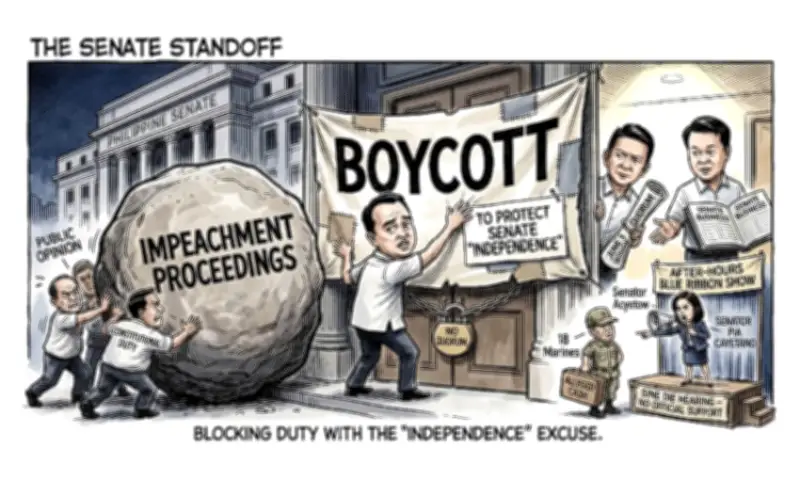
For weeks, the Senate had been practically immobilized as the bloc led by Senate President Alan Peter Cayetano refused to attend sessions, invoking the need to protect the “independence” of the Senate. To many observers, however, the boycott appeared less like a defense of institutional independence and more like a political maneuver that prevented the chamber from performing its constitutional duties.
Then, on June 3, Escudero attended the session, and the Senate finally resumed business after weeks of paralysis. Whether one agrees with him or not, Escudero offered a simple explanation: he was not changing sides but merely fulfilling his responsibility as an elected senator. I can only wish that other senators would embrace the same principle.
Criticism of Cayetano's Leadership
It is telling that even some of Cayetano’s law school batchmates from Ateneo de Manila University have publicly called on him to remember the values and virtues instilled by their alma mater. Former Senate presidents, including Franklin Drilon, have likewise questioned his continued hold on the Senate presidency.
The question therefore remains: What exactly is Cayetano holding on to? Leadership is exercised from the Senate floor, not from press conferences, social media platforms, or carefully crafted online videos. A Senate president is expected to lead deliberations, not avoid them.
Impeachment Trial of Vice President Sara Duterte
What the Cayetano bloc may have failed to appreciate is how their actions could be perceived by ordinary Filipinos. Recent surveys have consistently shown substantial public support for allowing the impeachment trial of Vice President Sara Duterte to proceed. The prolonged boycott inevitably fueled suspicions that the real objective was to derail or delay the impeachment process.
Ironically, the impeachment trial could provide Vice President Duterte her best opportunity to answer the accusations against her. A trial is, after all, the proper constitutional forum where evidence is presented, witnesses are examined and allegations are either substantiated or disproved. If her supporters truly believe in her innocence, they should welcome the proceedings rather than avoid them.
More importantly, the political reality suggests that conviction is far from certain. The Constitution requires a two-thirds vote of all senators to convict an impeached official. Given the present composition of the Senate, many observers believe the votes necessary for conviction may not even exist. The Diehard Duterte Supporters should recognize that, even assuming for the sake of argument that the prosecution presents substantial evidence, securing the constitutionally required votes for conviction remains an extraordinarily difficult task.
Controversial Blue Ribbon Committee Hearing
Instead of allowing the constitutional process to run its course, attention has shifted to the controversial June 4 Blue Ribbon Committee hearing chaired by Sen. Pia Cayetano. That proceeding, conducted after the Senate had already adjourned sine die, raised more questions than it answered.

To critics, the hearing appeared less like a genuine fact-finding inquiry and more like an exercise aimed at publicly identifying lawmakers who may later participate in the impeachment proceedings. Several members of the House prosecution team were named by the so-called “18 Marines,” who claimed in their sworn statements that they had delivered suitcases allegedly containing cash to various lawmakers. Those accusations, however, were promptly and categorically denied by the concerned lawmakers.
The controversy deepened when reports surfaced that there was no formal support from the Senate secretariat and staff during the hearing, leading some observers to question the regularity of the proceedings. Was it truly a committee hearing, or merely a highly publicized press briefing?
Allegations Against Senator Loren Legarda
Even more troubling was when the name of Sen. Loren Legarda was mentioned during the proceedings as one of the alleged recipients of cash-filled suitcases. This led Levito Baligod, the lawyer for the former soldiers, to admit to making a mistake in implicating Legarda and their statements regarding her have since been retracted.
If such a serious allegation can be withdrawn so casually, what does that say about the credibility of the entire narrative? The damage, unfortunately, may already have been done.
In politics, accusations often travel faster than corrections. A retraction rarely receives the same attention as the original allegation. Thus, even if the claim against Legarda was erroneous, her name had already been dragged into public controversy.
Conclusion: A Senate in Crisis
The Senate is not a courtroom of public opinion. It is a constitutional institution entrusted with the solemn duty of seeking truth. When allegations are aired without adequate verification, the casualty is not merely the reputation of those accused but also the credibility of the institution itself. This is a sad lesson from this episode.
At a time when the nation expects its senators to govern, deliberate and address pressing national concerns, the Senate has instead become consumed by political intrigue, factional warfare and spectacle.
We deserve better — a Senate that shows up, does its job and allows constitutional processes, including impeachment, to proceed without fear or favor.