The Philippine government has issued a strong rebuttal to China's recent allegations, firmly stating that its actions in the West Philippine Sea (WPS) are lawful duties of a sovereign state and not acts of escalation. This statement, released on Monday, January 12, 2026, directly addresses Beijing's claim that Manila is staging provocations in the contested waters.
A Firm Rejection of False Claims
In an official statement, the National Maritime Council (NMC) labeled China's accusation as "preposterous and completely false." The council clarified that the presence of Philippine government vessels and the operations of Filipino fisherfolk in the area are legitimate activities within the country's own maritime zones. "Filipino fishers are civilians lawfully pursuing their livelihoods within the Philippines’ maritime zones. Protecting them is a responsibility of the State, not an act of escalation," the NMC emphasized.
The council pointed out that the root of tensions lies in China's persistent activities, which it described using the acronym ICAD: Illegal, Coercive, Aggressive, and Deceptive. These actions, according to the Philippines, occur in areas unequivocally recognized as part of its exclusive economic zone (EEZ) under the United Nations Convention on the Law of the Sea (UNCLOS) and the landmark 2016 Arbitral Award.

Upholding International Law and the Arbitral Award
The Philippines reiterated that all its operations in the West Philippine Sea are conducted with clear, lawful objectives. These include ensuring maritime safety, providing humanitarian assistance, and enforcing Philippine laws. The NMC stressed that these actions are "legitimate, lawful and consistent with international law, particularly UNCLOS and the 2016 Arbitral Award."
The 2016 ruling by the Permanent Court of Arbitration in The Hague remains a cornerstone of the Philippine position. The tribunal invalidated China's expansive nine-dash line claim over the South China Sea and found that Beijing had violated Manila's sovereign rights by interfering with Philippine fishing and economic activities within its EEZ. China continues to reject this ruling.
Call for Restraint and Continued Dialogue
The NMC detailed a pattern of dangerous behavior by Chinese vessels and aircraft, which it says threatens regional stability. These reported ICAD activities include:
- Dangerous maneuvers and blocking of Philippine vessels.
- Ramming and intimidation tactics.
- The use or firing of water cannons against Philippine ships and Filipino fishers.
- Conducting dangerously close aerial maneuvers.
The council warned that such actions "place lives at risk, unnecessarily destroy property at sea, and undermine peace and stability in the WPS and the region."
Despite the firm stance, Manila kept the door open for diplomacy. "The Philippines remains open to constructive dialogue and consultations for the peaceful development of the region in accordance with international law," the statement concluded. It called on China anew to abide by UNCLOS and the 2016 Arbitral Award to ensure stability.
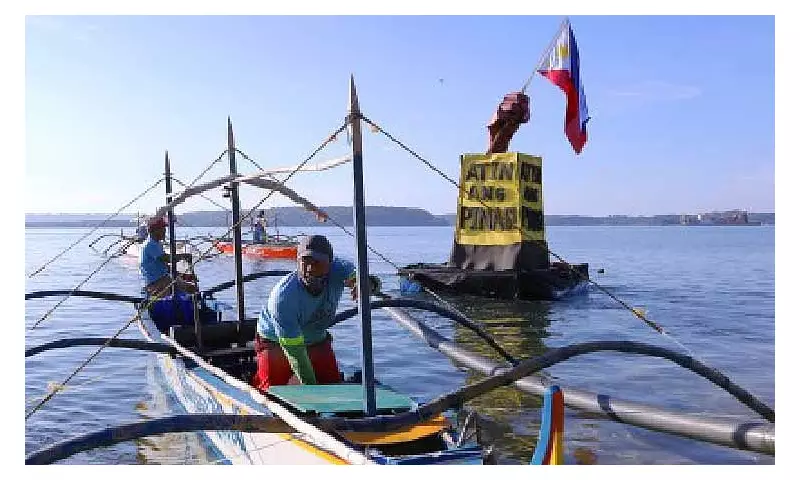
The issue remains a powerful symbol of national sovereignty for Filipinos. This was exemplified by an act of civilian defiance on November 6, 2023, when a group of fisherfolk from Barangay San Salvador, Masinloc, Zambales released an 18-foot symbolic buoy bearing the Philippine flag and a large sign that read "Atin ang Pinas" (The Philippines is Ours) into the waters, asserting their rights and connection to the sea.