Davao Region Fisheries Output Declines 5% in 2025, PSA Reports
Fisheries production in the Davao Region experienced a notable decline in 2025, as losses in aquaculture and municipal fishing sectors overshadowed gains in commercial and inland fisheries, according to the Philippine Statistics Authority (PSA). The agency's 2025 annual fisheries production report, released on March 23, 2026, reveals that total output dropped to 61,290.97 metric tons, a decrease of five percent from the 64,483.43 metric tons recorded in 2024.
Regional Production Trends by Province
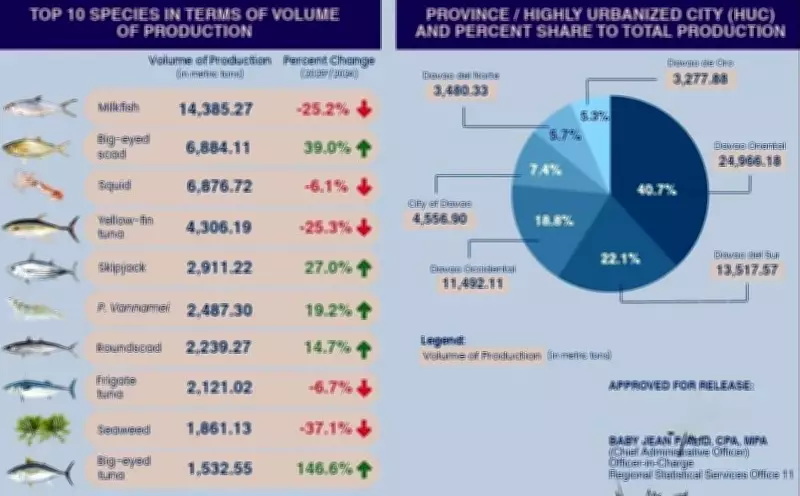
The overall decrease occurred despite production increases in most provinces, with a sharp decline in Davao del Sur significantly impacting the regional total. Davao Oriental led the region with 24,966.18 metric tons in 2025, up 4.3 percent from the previous year and accounting for 40.7 percent of total production. In contrast, Davao del Sur saw output plunge 40.8 percent to 13,517.57 metric tons. Other provinces showed modest gains: Davao Occidental rose 2.6 percent to 11,492.11 metric tons, Davao del Norte increased 4.9 percent to 3,480.33 metric tons, and Davao de Oro posted 3,277.88 metric tons, up 2.3 percent. The City of Davao contributed 4,556.90 metric tons.
Sectoral Performance Analysis
Commercial fisheries expanded sharply, with output climbing 57.6 percent to 10,530.17 metric tons in 2025. This sector, which involves fishing in marine waters beyond 15 kilometers from shore using vessels over three gross tons, was driven by Davao Oriental's 53.8 percent increase to 9,505.96 metric tons. However, Davao del Sur experienced a 65.9 percent drop in this category.

Marine municipal fisheries, defined as fishing in coastal waters up to 15 kilometers from shore using small boats or non-motorized methods, weakened across the region. Production fell 7.5 percent to 29,616.27 metric tons, with Davao del Sur posting the steepest decline of 40.2 percent.
Inland fisheries, involving activities in rivers and lakes, posted gains but remained minimal, increasing 41.5 percent to 36.77 metric tons. Davao del Sur led with a 156.3 percent surge, while Davao de Oro rose 80.9 percent.
Aquaculture, the cultivation of fish in controlled environments, contracted significantly by 18.1 percent to 21,107.75 metric tons. Davao del Sur recorded the largest drop of 40.5 percent, though Davao Oriental saw a dramatic 215.4 percent increase.
Top Species and Data Implications
Milkfish remained the top species in the region despite a decline in output to 14,385.27 metric tons. Big-eyed scad rose to second place with 6,884.11 metric tons, while squid slipped to third. The PSA emphasized that this data, based on quarterly surveys, supports agricultural performance monitoring and policy planning for the fisheries sector across the Davao Region.