Cebu spent more than P43 billion on 1,008 flood-control projects between 2016 and 2025, but many of the projects identified by a government study as critical to reducing flooding remain largely unimplemented, a SunStar Cebu investigation found.
A review of Department of Public Works and Highways (DPWH) project records, procurement data and the 2017 Metro Cebu Flood and Drainage System Master Plan shows that most flood-control spending went to riverbank protection, revetments, seawalls and slope-stabilization projects. In contrast, relatively little funding was directed toward upstream water-retention systems, watershed rehabilitation and other non-structural interventions that experts say are necessary to reduce flood risk across an entire river basin.
The findings raise questions about whether Cebu’s flood-control strategy has focused on protecting riverbanks and infrastructure while leaving many of the root causes of flooding unresolved.

A decade of rising spending
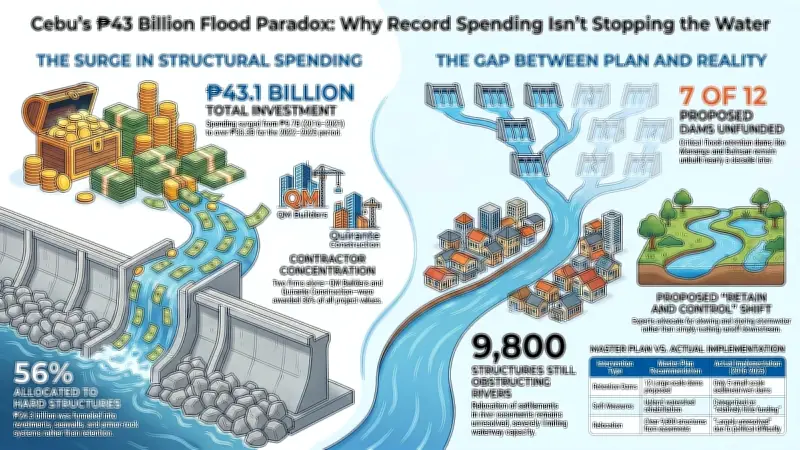
DPWH records show flood-control spending in Cebu rose dramatically over the past decade. From 2016 to 2021, recorded projects amounted to approximately P9.73 billion. Between 2022 and 2025, that figure surged to more than P33.38 billion.
SunStar analyzed 1,008 project entries listed under flood-control programs across Cebu from 2016 to 2025. More than P24.3 billion of the total spending was allocated to revetments, riverbank protection works, armor-rock systems, seawalls and similar structural interventions.
Major river systems, including the Mananga, Butuanon and Cansaga rivers, received repeated funding for desilting, riverbank protection and slope-stabilization projects. Coastal municipalities in southwestern Cebu also received billions of pesos for seawalls and storm-surge protection.
Many projects were implemented in multiple phases, with individual contracts often ranging from P50 million to P100 million.
The primary focus transitioned from urban drainage and river desilting in Metro Cebu to large-scale coastal defense and multi-phase river basin management across the province.
A massive budget surge was noted in 2023, where total projects amounted to P13.92 billion for 209 projects. Projects are focused on major river basins, which targets the protection of strategic public facilities.
There was also a shift in scope in early projects (2016-2018) often focused on localized gabion revetments and community drainage. By 2022–2025, the scope shifted toward high-value armor rock shoreline protection, tetrapod systems and complex weir dams costing nearly P100 million per phase.
From 2016 to 2025, the big three waterways: Mananga River (Talisay City), Butuanon River (Cebu and Mandaue Cities) and Cansaga River (Consolacion) received continuous, multi-year funding for revetments and desilting.
From 2016 to 2021, the administration of former President Rodrigo Duterte, the funding for flood control was heavily concentrated in urban centers and northern industrial corridors. Cebu City accounts for nearly 28 percent or P2,739,818,634.01 of the P9.73 billion for Cebu’s recorded projects. In the latter half of the decade, the southwestern municipalities (Malabuyoc, Ronda, Dumanjug and Alegria) of the 7th district emerged as the highest-funded corridor, receiving billions for storm surge protection and riverbank reinforcement.
The town of Consolacion in the 6th district became a primary focus after 2021, with significant investment in slope protection along critical road corridors like Panas and Lanipga.
What the master plan recommended
The spending pattern contrasts with recommendations contained in the Metro Cebu Flood and Drainage System Master Plan completed in 2017 and funded by DPWH.
The plan identified flooding as a watershed-wide problem requiring a combination of structural and non-structural interventions. Among its major recommendations were detention basins to temporarily store floodwater, construction of flood-control dams, watershed rehabilitation, stricter land-use regulation, relocation of structures occupying river easements and the creation of a unified metropolitan flood-management body.
The study warned that no single intervention would be sufficient on its own.
“Flooding cannot be solved by isolated projects,” the plan stated, emphasizing the need for integrated river-basin management.

Summary
- Cebu spent over P43 billion on 1,008 flood-control projects from 2016 to 2025, with more than P24.3 billion allocated to structural interventions like revetments, seawalls, and riverbank protection works.
- DPWH spending patterns contrast with the 2017 Metro Cebu Flood and Drainage System Master Plan, which recommended watershed rehabilitation and detention basins that remain largely unimplemented or unfunded.
- Major recommendations, including the construction of critical dams and the relocation of approximately 9,800 structures occupying river easements, face significant political and financial challenges, limiting flood-risk reduction effectiveness.
Projects that remain largely unfinished
SunStar found that many of the plan’s major recommendations remain only partially implemented or unfunded.
The master plan proposed at least 12 dams and mini-dams throughout Cebu to slow runoff and reduce flood peaks before water reaches downstream communities.
DPWH records reviewed by SunStar show only five sabo and weir dams were constructed during the period, with a combined project value of approximately P193.6 million.
Most were located in southern and western Cebu and were primarily designed for sediment control and water regulation rather than large-scale flood retention.
The proposed Mananga and Buhisan dams, identified in the plan as critical flood-control and water-supply infrastructure, have yet to be funded.
According to Dr. Danilo Jaque, a flood and water-management expert from HydroNet Consultants, modern hydrologists are championing a complete shift in strategy. Instead of rushing runoff away, the new approach focuses on a simple principle: retain and control. The goal is to slow down stormwater, store a portion of it, release it gradually and conserve it for future use whenever possible.
Similarly, the plan recommended detention basins in upstream areas such as Danao and Tuburan to temporarily hold stormwater. SunStar found relatively few projects corresponding to these recommendations.
Watershed rehabilitation also remains limited despite repeated warnings from experts that degraded upland forests contribute significantly to downstream flooding.
“The river is only part of the system,” said Engr. Maria Nenita Jumao-as, director of the Water Resources Center at the University of San Carlos. “If rainfall reaches urban areas too quickly because upstream forests are degraded, river walls alone cannot solve the problem,” she said.
The relocation challenge
Another major recommendation remains largely unresolved. The master plan identified approximately 9,800 structures occupying river easements across Metro Cebu. According to the study, these settlements reduce the carrying capacity of waterways and contribute to flooding during heavy rainfall.
Local officials interviewed for this report said relocation remains politically, financially and socially difficult.
As a result, many flood-control projects have been constructed alongside waterways where settlements continue to occupy portions of the river corridor.
“You can improve riverbanks, but if the channel itself remains constricted, flood risk is reduced only to a certain point,” said Jaque.
Can government prove the projects worked?
One of the most significant findings of the SunStar report is the absence of publicly available performance measurements.
Neither DPWH nor local governments maintain a consolidated database showing whether individual projects reduced flood depths, shortened flood duration or prevented economic losses.
Without such measurements, it is difficult to determine how much flood risk has actually been reduced despite billions in spending.
Hydrologists interviewed for this report stressed that revetments and seawalls can effectively prevent erosion and protect infrastructure. However, they cautioned that such projects do not automatically reduce flood volumes across an entire watershed.
“A flood-control wall may protect a specific road or riverbank,” Jumao-as said. “But flood risk across an entire watershed depends on many other factors.”
Residents still experience flooding
For residents of flood-prone communities, the debate over infrastructure priorities remains largely academic.
In Cebu City, residents in Barangay T. Padilla said flooding continues despite years of flood-control projects.
Yvette Yap, who has lived in the community for more than six decades, said flooding that once occurred primarily during major typhoons now happens during shorter periods of heavy rain.
“We see projects being built, but when strong or even regular rains come, the water still enters our homes,” she said.
Residents of Villa del Rio in Barangay Bacayan reported experiencing unprecedented flooding during typhoon Tino, with floodwaters reaching up to eight feet and sweeping away vehicles and household belongings.
Business owners in Mambaling and Subangdaku in Mandaue City expressed similar concerns, saying floods continue to disrupt operations and damage property.
While some residents acknowledged that flooding appears less severe than before in certain locations, many said the problem has not disappeared.
The contractor concentration
SunStar also found that a relatively small group of contractors accounted for a significant share of flood-control spending.
Project records show QM Builders and Quirante Construction Corp. were awarded projects with a combined value of approximately P15.5 billion between 2016 and 2025, representing roughly 36 percent of total recorded flood-control spending in Cebu.
Industry observers interviewed by SunStar said such concentration is not uncommon in large-scale infrastructure sectors where only a limited number of firms possess the equipment, workforce and financial capacity required to undertake major flood-control projects.
SunStar noted that concentration among a small number of contractors warrants continued public scrutiny given the scale of public spending involved.
Government response
SunStar sent requests for interview with DPWH 7 Director Simon Arias on May 11, 2026. On May 20, SunStar visited the regional office to pursue the interview, but was advised that the director is not available.
On May 25, Arias responded saying he cannot confirm a schedule due to prior appointments. A follow-up email was sent to Arias on June 2 and was informed that they are waiting for the approval of the central office for the interview.
SunStar sent an email to DPWH Secretary Vince Dizon on June 5, requesting his office to approve the request for interview with Arias with a response acknowledging receipt of the email and the request is being “reviewed and referred” to the concerned office for appropriate action.
As of this writing, SunStar received no feedback from the office of Arias and Dizon.
Meanwhile, provincial officials acknowledged the need for stronger metropolitan coordination.
Eleazar Sabinay, head of the Provincial Planning and Development Office, said Gov. Pamela Baricuatro is supporting efforts to reactivate a metropolitan coordinating body for Cebu.
“We need a body that will really look at this level, flooding does not respect political boundaries and we understand the level of the chief executives,” Sabinay said.
Currently, Sabinay said Governor Baricuatro is working with the Office of the President to issue an executive order that will mandate the creation of a body that will oversee all metropolitan issues.
Flooding beyond political boundaries
Nearly a decade after the Metro Cebu Flood and Drainage System Master Plan was completed, records show billions have been spent on flood-control infrastructure throughout the province.
Yet many of the plan’s most ambitious recommendations — flood-retention dams, detention basins, watershed rehabilitation, relocation programs and metropolitan-wide coordination — remain unfinished.
The master plan warned in 2017 that flood management would require more than concrete structures.
As climate change intensifies rainfall and urbanization continues to reshape Cebu’s watersheds, experts say the question is no longer how much government spends on flood control.
The question is whether it is spending on the interventions most likely to keep communities dry.