There was a time, back in the day, when Cebu and its residents were happy to be an “Island in the Pacific.” The slogan was successfully used during the late 1980s by the local government and private tourism operators to market Cebu to the outside world. Apparently, they wanted to distance themselves from what was happening in Manila, which was racked by mass demonstrations and protests against the administration of the dictator, Ferdinand Marcos Sr.
Although our family lived abroad, I heard my father and my uncles and aunts talk about it whenever we came home every other year for vacation. I could still remember the pride in their voices. There were even discussions of Cebu becoming another Singapore. When I think about it now, it seemed like a half-serious brag that was dripping in saudade, a profound, painful emptiness from missing what once was and what could have been.
I was in elementary school when we moved to Cebu from Davao in the late 1970s. I used to hang out in my grandmother’s house along Urgello St. during the weekends. It was there I learned about my late grandfather, Atty. Publio Albarracin Briones, who died in a car crash the year before I was born. I’ve always imagined him to be a great man, the way they spoke about him. He spoke fluent Spanish, they said, conversing in fluent Castilian with their Cuban neighbor. They said he had many Chinese friends, many of whom he helped become naturalized Filipinos. They said he was a successful businessman, with a warehouse in the downtown area and a store along Jones Ave. He was on the verge of buying a small ship to ferry goods to Mangagoy when he met his untimely death.

He left behind my grandmother Lola Mama; my father, the eldest; and his six younger siblings, the youngest being only seven years older than me. My grandfather’s older sister, my Lola Abing, never married. She sacrificed her future helping out at a well-to-do relative’s house so her younger brothers could go to school and finish college. She used to tell me stories of how she spent the war in Jolo, island-hopping in the cover of darkness, clinging to the trunks of banana trees and surviving on roots that they dug in the forests, all the while making sure that I finished the meatballs and humba that she had placed before me.
My Lola Abing was a very gaunt woman, but she was very strong. They said she contracted TB during the war. She made sure I had more than enough to eat during my visits and would proudly show me off, her chubby grandson, to relatives from Argao who often dropped by whenever they had business in the city.
The compound in Urgello was always full of people. At one time, my Lola Mama had 60 lady boarders, or maybe it was 50, either way, there were a lot, not to mention the many relatives who lived in the house while they studied here. And because I was the first grandchild and the only child in that very busy household along Urgello St. that had a small grocery store and a cafeteria downstairs and rooms full of boarders upstairs and in the next house, I had the run of the place.
Until now I remember the telephone number in Urgello. “76716.” It was in the office located at the back of the cafeteria counter. One time, I answered the phone. I must have sounded very haughty and imperious; the voice at the other end of the line asked who I was. I proudly replied, “Apo ko sa tagiya sa Manang’s Café (I am the grandchild of the owner of Manang’s Café).” Who is this? I asked him back. “Anak ko sa tagiya sa Manang’s Café (I am the son of the owner of Manang’s Café).” It turned out to be my Tito Boy, my father’s second younger brother who also happened to be Publio Jr.
The Briones siblings had diverse interests, but they were all voracious readers. There were books everywhere. They would all gather in the living room upstairs, discussing politics, literature and art. I knew about the Industrial Revolution and Marxism by the time I was in Grade 4. And I had a picture book to prove it. I never felt left out because they never treated me like a kid. Whenever I had questions, they would answer me without condescension. Come to think of it, that would explain why I felt like an old soul at such a young age.

When my Tita Fe sat on the piano, it was my cue to sit next to her. Then she would start playing from the Broadway songbook. I don’t remember how I learned the songs. But I know that it was Mame who coaxed the blues right out of the horn and that it was a beautiful morning because the corn is as high as an elephant’s eye and it looks like it’s climbing clear up to the sky.
Today, I can remember, in detail, the happier times. But we all know “life ain’t always a bed of roses.” But even during the dark times, which I would rather not share here, no one talked about the “Big One.” Back then I thought Cebu was immune to earthquakes.
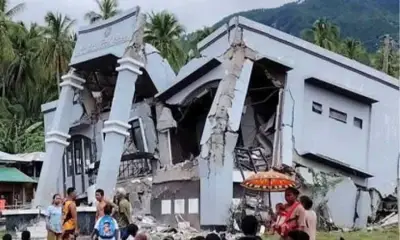
Back when I first joined the SunStar newsroom in 1997, I remember bragging to a Tagalog colleague, Mama Muy (Lilette Santos), that Cebu was an easy sell to investors and tourists because it rarely suffered violent typhoons or strong quakes. That confidence felt almost civic pride then — we thought geography had given us a kind of immunity. But now, after the recent tremor in southern Mindanao, Cebu authorities are scrambling to prepare for a possible magnitude 7.2 or 7.5 earthquake, and those old assumptions feel dangerously dated.
I don’t want to end this column on such a depressing note. After all, life is too short. To quote a catchphrase from a famous San Miguel commercial back in the 1980s and 1990s, “mag-beer muna tayo!” or, in my case, a lapad of five years would do just as fine.