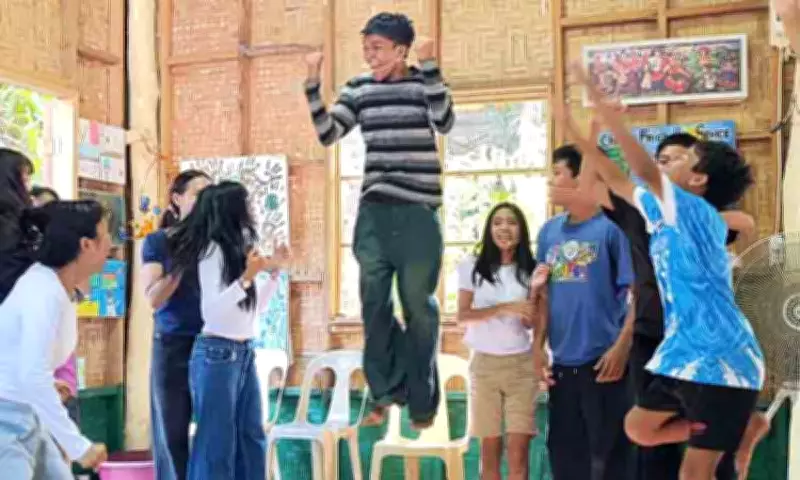
One would never think that a group of children is preparing for one of the most important performances of their year in the innermost corner of New Lanzona Village in Davao City, inside a seemingly unfinished shelter with no ceiling. Tucked along the edge of the village, past rows of homes and surrounded by trees, stands the Tambayan Center for Children’s Rights Inc., where 19 children are taking steps toward a better future.
Half of the rehearsal space is made of cement, the other half of wood. By afternoon, the heat builds up inside, forcing the group to turn the ceiling and electric fans on full blast so the children can continue practicing. Despite the conditions, the 19 children gave their all: singing with full hearts and dancing joyfully to music blasting from speakers. In those moments, they are free to simply be children.
Background of the Young Performers
Daisy Apat, production manager of I Dream of Light (Idol), the theatre group of the Tambayan Center, said the children come from partner communities across five barangays: 21-C, 22, 23, 76-A, and Talomo Proper. She added that the children involved in the play are those with identified individual and group cases handled by the center. Many come from difficult backgrounds: children from dysfunctional families, those who wander the streets due to conflict at home, those raised by grandparents, those used as drug couriers, and those who have experienced sexual and physical abuse.

The theatre project began in 2025 and was proposed to the National Commission for Culture and the Arts (NCCA). It was approved in November 2025, marking the start of production. “The process of telling their stories in a different way is also therapeutic. It has a therapeutic effect on the children, because most of these are cases handled by Tambayan where you can really say they are still trying to survive through their day-to-day problems,” Daisy told SunStar Davao on April 23, 2026.
The performers, aged 11 to 19, include six boys and 13 girls. Originally, there were 23 participants, but some withdrew due to relocation, schooling, and health concerns. The remaining 19 trained for 25 days and will perform for five days. Daisy emphasized that while many of the children face hardship outside the center, Tambayan ensures they are safe, fed, and supported during their time there. They are given time to rest before rehearsals begin.
Stories Told by Children
The play draws directly from the children’s lived experiences. Before writing began, facilitators conducted a three-day workshop that included issue analysis and processing sessions to identify the themes the children wanted to highlight. Antonio E. Apat, playwright and artistic director, said the script was shaped with the children’s input, reflecting realities such as riots, substance and sexual abuse, corporal punishment, hunger, and family conflict. These struggles often push children into street life — begging, selling ukay-ukay, or taking on small jobs just to survive.
Antonio said the center found theatre to be one of the most effective ways to help children build character, which led to the creation of the project. While the stories came from the children, he finalized the script due to time constraints, with the children’s approval. The play is titled “Kadalanan sa Paglaum” (Streets of Hope), reflecting how the streets that shaped their struggles can also lead them toward a better life.
Daisy said the play centers on three characters representing key experiences of the children. She hopes it becomes a platform for change. “A change in behavior, a change in perspective—even if their situation hasn’t changed and may take a long time to improve—the way they view things and respond to their circumstances can shift. I hope there will be signs they themselves can recognize that something has changed,” she said.

Opportunity for Children
For many of the participants, Davao City’s streets once served as their refuge from broken homes. Through theatre, they now have a space to tell stories that often go unheard. Eighteen-year-old Edsil P. Peling, who plays Yoseph, joined Idol at 15 without knowing anything about theatre. At the time, he said, he was simply a “tambay.” Over time, he discovered his talent for acting and has since performed in various places, including Manila. Though used to lead roles, Edsil admitted he struggled with singing at first. With practice and encouragement, he found confidence in his voice.
“Don’t give up on your dreams. If you have dreams, you have hope. Don’t think that this is all there is for you—you still have something more to show,” he said. Seventeen-year-old Jayben Q. Sabani, who plays Vincent, also described himself as a former “tambay” with no interest in theatre before joining Idol. He said the experience helped him discover his abilities and build confidence. “You should join—you might not realize your talent can be developed professionally. You can showcase your abilities in singing, acting, and drama,” he said.
Meanwhile, 16-year-old Kristal Jane Lor, who plays Remy, initially doubted her ability to act, as she was more comfortable singing and dancing. Now, she has embraced performing fully. “If you want to feel that you have something to achieve, go for it. Don’t hesitate—if you want to pursue your talent, don’t hide it, explore it,” she said. She added that her grandmother, who raised her, expressed pride in her involvement in the play.
Performance and Purpose
Idol, founded in 2013, has long conducted advocacy performances on children’s rights and the United Nations Convention on the Rights of the Child. However, this marks the group’s first full theatrical production. The play blends poetry, drama, singing, and dancing. It is performed in Cebuano, with songs in both Cebuano and Filipino, and runs for about 50 minutes.
Training the children was not without challenges. Daisy said facilitators had to be patient and attentive, as many participants came from difficult environments. Emotional themes sometimes triggered reactions, requiring careful guidance and support. Antonio added that children are allowed to rest when tired or overwhelmed, resuming practice when ready. Despite limited time, significant progress has been observed.
Vocal coach Don James William R. Estomo said teaching the group was initially challenging, especially with choral arrangements, but he has seen remarkable growth. “Seeing them grow from non-singers into people who actually listen to the technical aspects, even if I don’t require them to be 100 percent perfect singers, their willingness to do it is what also made me want to keep doing this,” he said.
Antonio hopes the lessons the children gained will stay with them beyond the stage. “The real drama is our everyday life—from the moment we wake up until we go to sleep,” he said.
The children will perform on May 4 and 6 at the Barangay 22-C Covered Court, May 7 at Barangay 76-A, and May 8 at Barangay Talomo Proper—sharing not just their talents, but their stories. Idol is also encouraging the public to support the production through donations, sponsorships, and meal assistance to help sustain the needs of the children and continue raising awareness about their plight.