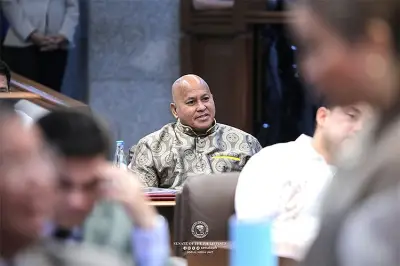
Senator Imee Marcos has taken a firm stand against the proposed national budget for 2026, publicly declaring her refusal to endorse the spending plan approved by Congress. In an official statement released on December 31, 2025, Marcos labeled the P6.793 trillion General Appropriations Act (GAA) as the "Giniling Budget," asserting it remains a form of disguised political pork.
The Core of the Controversy: Flagship Projects and 'Soft Pork'
The senator outlined two primary reasons for her opposition. First, she expressed strong disagreement with the significant reduction of funds intended for key government flagship projects. Specifically, Marcos highlighted the slashing of allocations for foreign-assisted projects under the Department of Public Works and Highways (DPWH) and the Department of Transportation (DOTr). The total amount removed from the President's proposed National Expenditures Program (NEP) reached a staggering P124.54 billion.
Her second major point of contention involves the reallocation of these funds. Marcos argued that the money cut from critical areas like flood control was improperly diverted to what she described as "soft pork" programs. She named initiatives such as MAIFIP, AICS, TUPAD, PAFF, FMR, and LGSF, which have long been suspected of being tied to political incentives. "This budget is still GINILED-pork," Marcos stated, "it's just ground up so it's not obvious."

A Defiant Stand on the Power of the Purse
While acknowledging the constitutional "power of the purse" held by Congress, Senator Marcos made it clear that recognition does not equate to endorsement. "I did not sign the 2026 GAA Bicameral Conference Committee Report and its ratification in the Senate," her declaration firmly noted. This move places her in a distinct minority as the budget, having passed through Congress, moves to the Senate for review and potential amendment before being sent to the President's office for final signature or veto.
The senator's refusal to sign is a significant political statement, framing the massive national budget not as a tool for development but as a continuation of questionable allocation practices. By calling it "Giniling" (ground), she accuses her colleagues of merely repackaging old pork barrel mechanisms in a less detectable form. This act of defiance sets the stage for further debate as the 2026 budget moves through the final stages of the legislative process.