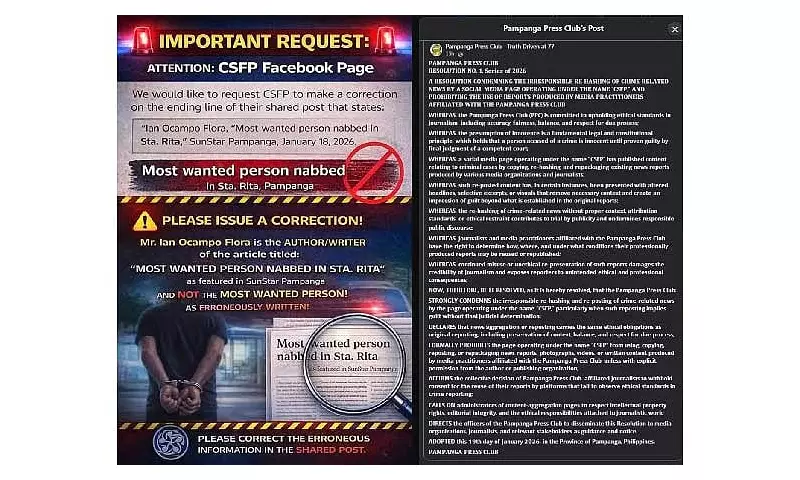
The Pampanga Press Club (PPC) has issued a strong condemnation against a Facebook page for what it calls the irresponsible rehashing of crime news, an act it says severely undermines journalistic ethics and the legal principle of presumption of innocence.
Journalist Mistaken for Most Wanted Suspect
The controversy centers on a post by the Facebook page "CSFP." The page republished a news report about the arrest of a most wanted person in Sta. Rita, Pampanga. However, the repost allegedly presented the information in a manner that led to significant public confusion.
At the heart of the confusion was Ian Ocampo Flora, a multi-awarded journalist from SunStar Pampanga and the current Executive Vice President of the PPC. Flora was the author of the original news article. The Facebook repost, however, placed his name alongside the headline "Most wanted person nabbed in Sta. Rita" without making it clear that he was the reporter, not the subject of the arrest.

This lack of context and proper attribution had immediate consequences. Flora revealed that following the repost, some netizens mistakenly believed he was the one who had been arrested. At least one online comment directly reflected this misinterpretation, causing reputational harm to the journalist.
Formal Condemnation and Cease-and-Desist
In response to this incident, the Pampanga Press Club took formal action. On January 20, 2026, the organization issued Resolution No. 1, Series of 2026. This resolution formally condemns the practice of rehashing and reposting crime-related news without proper context, attribution, or prior consent from the original journalist or media outlet.
The resolution serves a dual purpose. Firstly, it is a public statement upholding the standards of ethical journalism. Secondly, it acts as a clear cease-and-desist notice. The PPC explicitly stated that its affiliated journalists do not authorize the copying or reposting of their reports, photographs, or videos without express permission.
Upholding Ethics in the Digital Age
The PPC emphasized the critical importance of accuracy and responsibility in sharing news, especially in the fast-paced environment of social media. The club highlighted how careless reposting can lead to:
- Severe reputational damage to individuals.
- Widespread public misunderstanding.
- Erosion of trust in media.
- Violation of the presumption of innocence, a cornerstone of justice.
By the time the PPC's statement was released, the controversial Facebook post had already been taken down. However, the incident has sparked a broader conversation about content sharing practices and the ethical obligations of social media pages that disseminate news.
This event underscores the ongoing challenges media professionals face in protecting their work and their identities in an era where information can be easily distorted when stripped of its original context and journalistic framing.