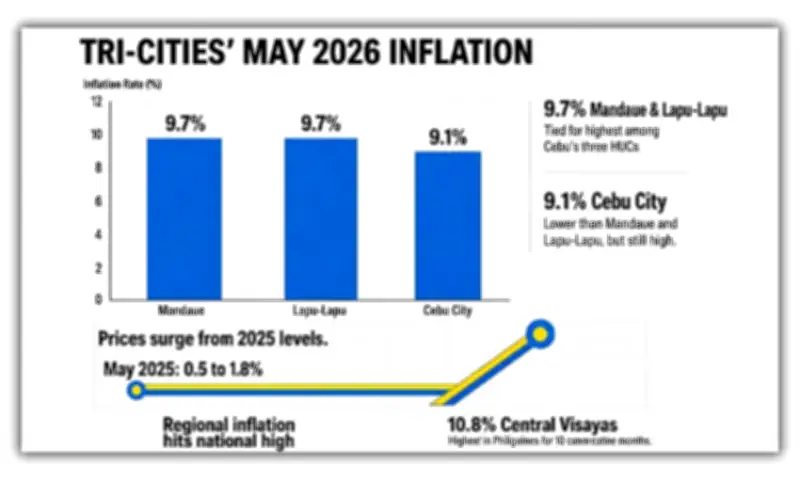
Lapu-Lapu and Mandaue cities tied for the highest inflation rate among Cebu’s three highly urbanized cities in May 2026 at 9.7 percent, according to Philippine Statistics Authority (PSA) 7 data released Monday, June 15, 2026.
The two cities outpaced Cebu City, which recorded a 9.1 percent inflation rate in May. All three cities also posted rates above their levels a year earlier, showing continued pressure on households from food, transport, utilities and other essential goods and services. Inflation is the sustained and general increase in the price level of goods and services in an economy over a period of time.
Inflation Trends in the Three Cities
In Lapu-Lapu City, inflation eased in May from 11.4 percent in April, but remained above the 1.8 percent recorded in May 2025.

Mandaue City’s inflation slowed from 10.7 percent in April to 9.7 percent in May. The May inflation rate, however, was still above the one percent posted in the same month in 2025.
As for Cebu City, its inflation rate declined to 9.1 percent in May from 9.4 percent in April, but it remained above the 0.5 percent recorded in May last year.
The elevated inflation rates in the three highly urbanized cities reflected the broader trend in Central Visayas, which posted the highest inflation rate among all regions in the country for the 10th straight month at 10.8 percent.
Regional Pressure
Central Visayas, which is composed of the provinces of Bohol and Cebu, has recorded the highest inflation rate nationwide since August 2025, when its inflation rate reached three percent. The rate rose to 4.1 percent in September, eased to 2.6 percent in October, climbed to 3.3 percent in November and 3.8 percent in December, then increased to 5.6 percent in January 2026.
The region’s inflation rate continued to rise in the succeeding months, reaching six percent in February, 7.4 percent in March and 10.8 percent in April. It stayed at 10.8 percent in May.
Senior economic specialist Raffy Dave Boyles of the Department of Economy, Planning and Development (DepDev) 7 said the region’s persistent inflation has been driven by higher costs for food, transport, power and water.
Island Constraints
Boyles said Central Visayas’ island geography, limited land area, growing population and supply constraints have pushed commodity prices higher than in other regions.
Among all regions, Central Visayas posted the highest inflation rate at 10.8 percent in May, followed by Caraga at 9.4 percent.
Food and non-alcoholic beverages remained the biggest contributor to Central Visayas’ inflation, accounting for 54.9 percent of the overall rate. Transport and housing, water, electricity, gas and other fuels followed.
Food inflation rose to 16.2 percent in May from 15.4 percent in April, with cereals and cereal products accounting for the largest share of the increase in food prices. Fish and other seafood, along with vegetables, tubers, plantains, cooking bananas and pulses, also contributed to the increase.